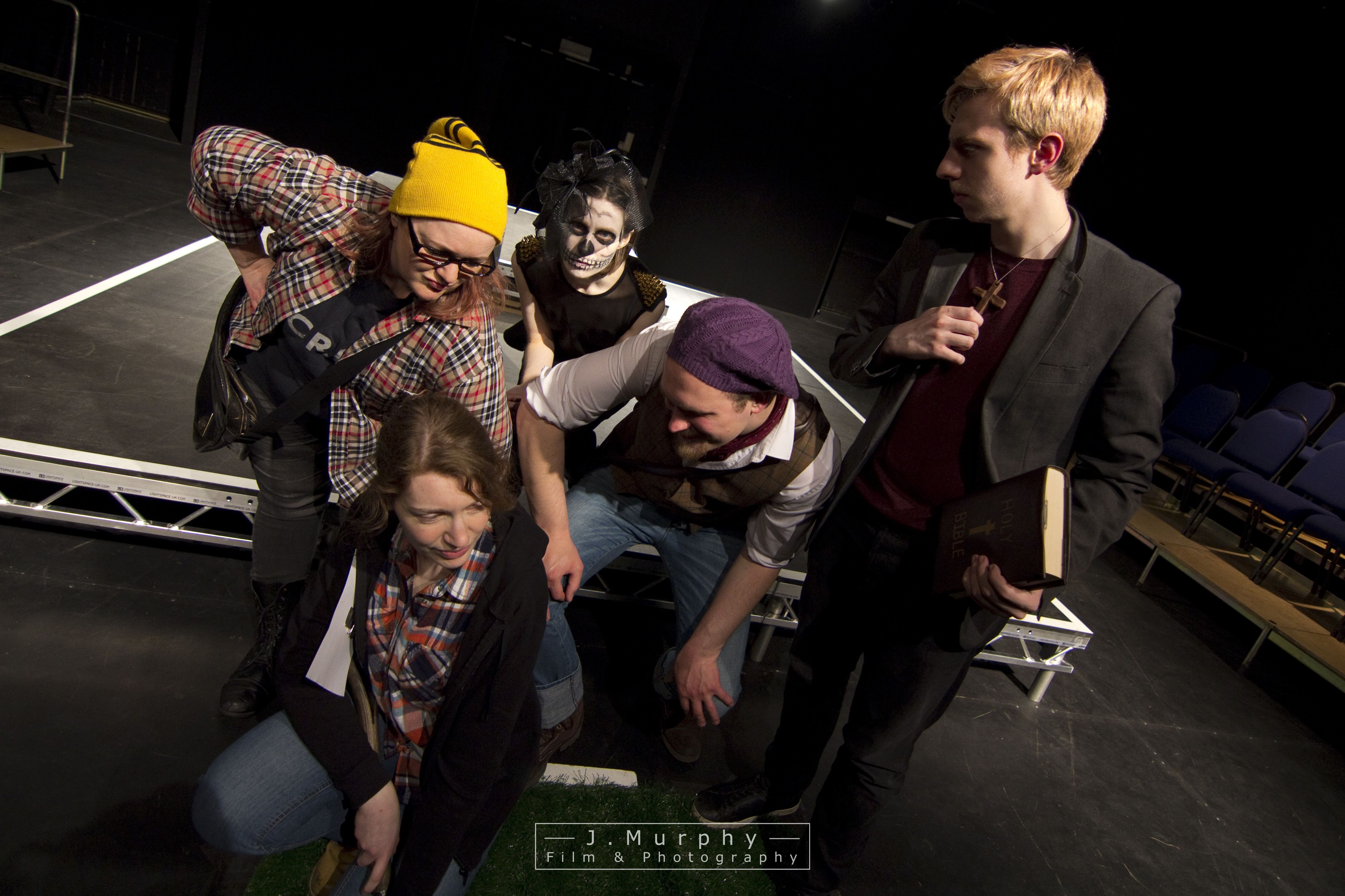
Report From The Field: Performances at the 2016 METh Conference

During the past weekend, our Artistic Director took some leave from working on our revival of ‘Mankind’ to attend the Early English Drama & Performance Network and Medieval English Theatre conferences. Her personal thoughts from the events follow and we will be back with more on ‘Mankind’ next week.

If you follow us on Twitter, you’ve probably noticed that I was at a conference this weekend. (Technically, this year, a pair of one-day conferences.) I tend to think of METh (Medieval English Theatre) as the “annual pilgrimage”, when Britain’s medieval drama scholars – and some aficionados from outside formal academia – make their way to a gathering spot, to spend some time sharing new research and discoveries, exchanging ideas, seeing performances, making new contacts, and generally checking in with the current state of the field.

I’ve been going to METh for about eight years now. It has a wonderful way of both changing and staying the same. On the latter front, there is much of the “old home week” about it: most of us only see one another once or twice a year, and it’s a much-appreciated opportunity to catch up with people you not only respect as colleagues, but also consider friends. The papers are always fascinating – and remarkably diverse. You might think that in such a small, specific field, there’d be a limit to the directions study could take, but there seemingly isn’t. Every year you can learn something new. And, in the ‘new’ column is the fact that this was the first year where METh met as an official society. For the most part that doesn’t change the way things function, but it does mean that there is now an organisation that you can join to formally be part of this community and keep up with what’s going on, if you’re interested in medieval drama. The other change I’ve noticed is that, where a few years ago I was the “baby” of the group, there is now a decent percentage of postgraduate scholars and early-career researchers in the field, which is a healthy sign for the future.

As I realise that most of you aren’t medieval academics, I won’t try to give you a précis of every paper given; if you’re curious, do check us out on Twitter for some highlights as they happened. Instead, I want to mention the part of the conference that is probably of most interest to you as theatre fans – the performance. Actually, there were two this year: a one-act play on Friday night, ‘Marge & Jules’, about medieval writers and mystics Margery Kempe and Julian of Norwich, and on Saturday afternoon, ‘John of Beverley’, a Dutch interlude about a British saint.

‘Marge & Jules’ is a wonderful example of what you can do when creating drama from historical records. Both Margery Kempe and Julian of Norwich left their stories to us: Margery’s is considered the first autobiography in English (1430s), and Julian’s is the first book in English by a woman (c. 1395). They’re both interesting as figures, and the obvious parallels and differences in their stories make them a good pairing for study. They did actually meet, and most of the script was taken from their actual writings. It’s less a plot-driven story and more a pair of character studies, but it’s a fantastic example of the way that history almost tells its own stories at times – and the play does a good job of exploiting the gentle humour that we might find in the quirks of these two women, as well as their virtues.

‘John of Beverley’ is less straightforward: an actual English saint who died in the early 8th century, the play is actually early 16th century Dutch, and the METh performance was translated into English. How John made that journey isn’t clear, nor is the way in which his story was transformed into that of the play. And it is a truly bizarre and comic thing. The plot hinges on the pious hermit John being duped by the devil into making the choice to either drink until drunk, or commit more heinous acts, including murder. He decides to get drunk, at which point he commits the other sins anyway, and then repents by becoming a hairy wild man creeping about the forest like an animal, until he is finally given a sign that God forgives him. This description doesn’t even begin to cover what a strange tale it is, and one of the major discussion points after the performance was whether it was intended to be as hilarious as we all found it, or whether it was meant to be taken with a certain degree of genuine piety.

It’s (to me) hard to imagine that any audience could fail to snicker at John’s uncertainty as to whether or not drunkenness was on the same moral par as homicide. I think it’s also worthwhile to consider that, even if the play was, by some chance, meant to be more serious than this production, or our response to it, might suggest, that doesn’t necessarily mean that we, today, have to maintain a serious approach. It was also a good example of the fact that a text which might look merely confusing on paper can be elevated through performance and direction. Little details – the amazing costume for John as the wild man, or the narrator cooing at a baby made from a shawl – made the play utterly hilarious. We don’t often credit medieval or early-modern drama as having a sense of the absurd, but I think that says more about our assumptions about the past and its people than what the evidence shows.

There aren’t all that many opportunities to see medieval plays in action, and METh is one of the rare occasions where I get to do so. It’s also a chance to talk to other people who spend part of their time working on historically informed drama, an equally rare thing. Inevitably there are some interesting debates about approaches: to adapt or translate? To emphasise the medieval or to emphasise the continuity? And there is almost always a point where we acknowledge that, despite all of our efforts in both academic and performative terms, attitudes about ‘medieval drama’ outside of our own specialist enclave seem incredibly hard to shift. These are matters that apply to both medieval drama studies and production. HIDden, in its earliest inception, was our answer: maybe by continuing to force a permeability between those two facets, more people can appreciate and enjoy plays like these, and maybe someday medieval drama can move out of the shadows. Even as HIDden begins to move away itself into a more diverse theatrical path, I still hope we can play a part in that.

For more information on Medieval English Theatre, the organisation and the publication, as well as future events, please visit: medievalenglishtheatre.co.uk

Director’s Notes: On Recasting

Following our recent need to recruit some new cast members for our revival of ‘Mankind’, our Artistic Director shares some of her opinions on the idea and process of recasting.

I’ve always marvelled at the phenomenon of long-running shows, or those which tour multiple companies of the same production simultaneously. A sort of “quality control” aims to make sure that audiences in Beijing, Los Angeles, or Leeds are seeing pretty much the same thing; you can see the production in 1990 and again in 2010 and it looks more or less identical. It’s not so much the degree of planning and oversight it must take to pull this off. It’s the actors. Dozens of individuals, with their own talents and creative processes, somehow manage to inhabit the same character, and in very nearly the same way. I’ve often wondered what it must mean to them, creatively, to not only have to do their basic job of acting, but to do it knowing that there is, effectively, only one “right” result.

Since we have been faced with the task of recasting a few parts for our revival of Mankind, due to some actors from our November production being unable to return, I’ve been thinking about this a great deal. As we’re trying to keep it quite similar to that earlier performance, we don’t want a significant shakeup in the characterizations. But I also believe firmly that actors have to be allowed to find their own way to a character, to merge what is on the page with what they imagine. Performances aren’t things which roll off a conveyor belt, identical; you can’t just put Actor A into Actor B’s place and expect that everything will stay the same, not if you actually value their work and their contribution to the process.

This is especially true, I think, with medieval drama, where the “character clues” in the text are fewer. With characters drawn to type and non-specificity, their individuality and believability comes largely from what the actors bring to the table. The characters that are built, and their relationships with one another, are open to an awful lot of interpretation. Because we aren’t starting from scratch, in casting we needed to contemplate not only whether an actor would fit well with a part, but how well they might “click” with their opposite – Mercy with Mankind, or the two N’s. After all, while actor chemistry isn’t necessary, it certainly helps!

This was very much held in mind as we were recasting the vacant roles. As always in casting, there’s an element of gambling involved, of trying, instinctively, to imagine how people will work together and how the personality you meet at an audition or interview will translate into a working process and resultant performance. Parameters or pre-existing ideas, born of an earlier run of the production, definitely make this process more challenging.

We were fortunate to have a fantastic cast in November, and I think we’re equally fortunate in our April group. Our new people are talented and enthusiastic, and as always I’m looking forward to get into rehearsals and see where they go with their parts. Helping them find their own path into previously established roles will be an interesting challenge: I want to give them room to discover and create, without the results taking the production in a different direction than the one we’ve already set. Unlike a first performance, the sky isn’t really the limit; at this point, there actually are “wrong” answers. But if creating a performance is a journey, there are many different roads you can take to arrive at similar destinations.

If you had the chance to see our November performance of Mankind, I do hope you’ll come along for the April revival and see what might have come from our experiences on those different “paths”!

‘Mankind’: Defining Our Revival

We have had long discussions about what constitutes a revival and what we hope to achieve in April by returning to ‘Mankind’.  Our Artistic Director sets out some of our conclusions below.

Revival:

  1. The action of reviving something after decline or discontinuance; restoration to general use
  2. The action or an act of staging a new production of an old play, musical, etc.,
  3. Restoration or return to life or consciousness
  4. Restoration to activity or vigour; improvement in condition, strength, etc.

                                             – Oxford English Dictionary

Revival is one of those very tricky words, where everyone thinks they know what it means, but often you end up with different interpretations.

To give one example: during the 1951 productions of the York, Chester, and Coventry mystery play cycles, each one was referred to as a “revival”, because it was bringing back plays that hadn’t been seen for more than four hundred years. Yet none of them was performed in the original Middle English, and all of them were radically reworked. In York entire plays were cut to create one omnibus play; in Chester a few lines were kept from each play so that they could claim they’d performed the “entire” cycle; in Coventry, the two surviving plays were elided together into one. Are these revivals? Re-imaginings? Re-creations? And where does that leave the subsequent half-century of regular performances, most of which have involved a new (reworked) script, new music, new casts, and entirely different staging? Are these the revivals? According to the definitions given by the OED, they are also revivals, in any definition. And yet those other words also feel tempting, and perhaps more accurate.

All historic drama is revival, inherently, but they are always revivals of plays rather than productions. With medieval drama in particular, we simply don’t know enough about their original staging to revive those productions. And, given that the cycle plays, at least, were being performed regularly for multiple centuries, one would be hard-pressed to define any version as “definitive”. They were revivals even in their own – long – period.

When it came to our production of Mankind, we set out to define what we meant by revival very deliberately. Although our production is a revival in the second definition given above when compared to the medieval original, we are not creating a new production from scratch. We are, rather, dusting off the one from last autumn. There will be some changes, but we are keeping it as close to November’s performance as possible. These changes are more in line with what might be expected if a production is on tour: details change as venues do, but the essential aspects of the piece remain the same. Ours is a “return to life” rather than a new production altogether.

As a process, then, we have been careful to only change those things which are required of necessity, rather than desire. Just because we could do something differently, doesn’t mean we should in this case. Sure, it might be fun to let Titivillus enter with a fanfare and pyros going off, but that wasn’t part of the original plan, so it won’t be there now, either. The change in venue means we have to reconsider some of the entrances and exits; they will be kept as close to the original intention as possible, although their dramatic impact is more important than actual physical proximity to the November performance. How the relationship with the audience will change, when some of them are in raised seating, remains to be seen; the hope is that the answer is “not terribly much”. We have consciously tried to keep the intimacy of the audience/actor relationship, as we feel that this juxtaposition works particularly well for medieval drama, given that it was written for performance with a physically proximate audience and a lack of the “fourth wall” boundaries that we’re so accustomed to today.

No doubt there will be other challenges as we progress toward the performances in April. What shouldn’t change are the impressive talents and enthusiasm of the cast, or the distinct sense of fun that this most delightful of medieval plays offers.

Director’s Notes: Why Revive ‘Mankind’?

This week Laura, our Artistic Director, explains some of the reasons behind our upcoming revival of ‘Mankind’.

Given that there are several pages of “that would be an interesting project” lists in the HIDden files, it might come as a surprise that we’re dusting off Mankind and putting it on again. Although it is one of my favourite medieval English plays, there are a lot of reasons beyond that for why it’s coming back, and we thought it would be nice to let you in on our logic.

Our production last November was something we were really proud of. In our ideal world, it would not have been a one-off performance. Circumstances beyond our control, meant that we had to limit the performance to a single evening. And that was a shame, because we knew that there were lots of people who had wanted to come but could not be there on that one and only night. Moreover, we have a brilliant cast who put a lot of hard work and energy into the play, and they deserved more than one night’s showing of what they’d created. So we were toying with the idea that we might bring it out again, even before that performance happened.

Another major factor was an unexpected opening in our calendar. We had been in discussion with Charles Hunt about putting on the York Fall of Angels this spring, to go along with the Mystery Plays taking part in the Minster during the mid-summer. In 2012 we worked with Charles to produce The Noah Play on a waggon in the streets of York, as an adjunct to the large-scale production in St Mary’s Abbey. It was a nice reminder that the plays have a dual history, and that both forms have come to have a place in York’s heart and history. We were looking forward to doing it again.

Sadly, Charles passed away suddenly in November, on the day that Mankind was performed. We didn’t think that it would be right to continue with The Fall of Angels without him, as it had been his brainchild in the beginning, and so we were suddenly left without a spring project. With the cast still nearby and probably able to remember the production easily, it made sense to use the space for the theoretical revival of Mankind. The production is dedicated to Charles’ memory, not only because of the timing, but because if he had been in better health we felt he would have made a wonderful member of the cast. We knew he wouldn’t be able to take on that project, but one of Charles’s great gifts was for fostering new talent, and we’re sure he would have approved of how the character turned out.

Staging another medieval play in some proximity to the Mystery Plays, which have evolved far beyond their twentieth century status as “medieval revivals” into being a modern phenomenon in their own right, was important to us as a way of continuing to give the community a connection to the historic aspects of the plays of that era. But (without getting into the academic arguments about an evolutionary model of drama development) we are also looking at Mankind as a step forward in theatre, too. We are hoping it will be part of a greater exploration of some of the directions morality plays took as time went along.

Not all decisions are written in moonlight and dreams, some are utterly practical and hard-headed. In most respects, the revival of Mankind comes from that sort of pragmatism. But that’s not to say we aren’t excited about it. It will be nice to get this wonderful group back together, and to share this very funny and occasionally sweet story with more of you! We hope you’ll be there with us to see it!

Director’s Notes: Repeat, Replay

In anticipation of our revival of Mankind our Artistic Director contemplates the revisiting of art.

“That’s one thing that’s always… been a major difference, between the performing arts, to me, and being a painter… A painter does a painting, and he does a painting, that’s it, you know? He’s had the joy of creating it and he hangs it on some wall somewhere, somebody buys it, somebody buys it again, or maybe nobody buys it… but nobody ever says to him, nobody ever said to Van Gogh, “Paint ‘A Starry Night’ again, man!”-Joni Mitchell

That quote is at the beginning of a recording of a song I’ve listened to over and over again – literally thousands of times, I’m sure, over the past twenty-five years. (“Circle Game”, on Miles of Aisles). I’m that person who will play a song on loop for days, or weeks. So I appreciate the spirit Mitchell is talking about – that some things are so loved, we return to them again and again and again. But it was only last week that I really stopped to think about it, and I came to the conclusion that “finished” art actually isn’t, and that you don’t truly perform the same thing over and over again, even if it may initially seem that way. And it seemed relevant, as we are preparing to return to Mankind again, to share that with you.

In fact, art (by which I mean “fixed” art- painting, sculpting, etc. – something where there is a tangible end product) is reproduced all the time. Today it is also photographed and digitised, but you can still see art students in galleries learning their craft through copying the masters. You’ve probably seen “Starry Night” on coffee mugs, or calendars. Is it the same thing as the original? Of course not, but you’d still recognise what it was – much like seeing two different performances of the same play. Different brush strokes, same overall impression.

Moreover, although we tend to see a painting as simply existing, that is not enough: like performance, it has an audience. There is a viewer who interacts with it in some fashion, even if that is just a glance; they contemplate what it means, or are captivated by its colours. Visual art is exactly that: meant to be seen. And just like a play, a different audience on a different occasion will see different things. Maybe the lighting will be slightly brighter, or the viewer is sleepy. It will change what they see and how they feel about it. The initial act of painting may be singular – it’s true that Van Gogh only really got to do that specific copy of the painting one time – but between varieties of copying and the long life of the physical painting, it is revisited over and over. The difference, then, between the kind of art you hang on the wall in a museum and the kind you see when you go to a performance is largely a question of tangible durability.

So… we’re coming back to Mankind. I’m not claiming it’s a masterpiece in any way comparable to a Van Gogh painting. But I am rather fond of the production. It’s one of my favourite medieval plays, and the cast are a lovely group of people who bring it to life delightfully. Unlike the performance in November, which was a further step from our initial staged reading in Bristol, we’re not making major changes: we’re pretty happy with the show we have. Last autumn, circumstances meant that we couldn’t give it the run we would have liked it to have. It deserves a wider audience. And so we decided to do it again.

It won’t be exactly the same production, any more than a photograph of “A Starry Night” is “A Starry Night”. Time changes things, and no two performances are identical anyway. We’re in a different venue, one which will speak more to the modern qualities of the production than the medieval. The cast will be slightly different. We’ll probably have the opportunity to perfect a few minor details. But it’s still our Mankind, brought back to life, and maybe with a few small adjustments. I for one can’t wait.

HIDden Theatre Presents ‘Mankind’, a Revival

We are very excited to be reviving our production of Mankind from last Autumn at Upstage Theatre, 41 Monkgate, York for a run of four performances 14th-16th April 2016, 7.30pm with a Saturday matinée at 2.30pm.  The Friday performance will be followed by a post-show talk and discussion.

Join us for a performance of the funniest of English medieval plays! Mankind is the story of a farmer’s temptation away from his work by a group of Vices and demons, intent on getting him hooked on the pleasures of the modern world at the expense of his higher nature. Will he be saved by the loyal friendship of Mercy, or will he give in to the fashionable whims offered him by Mischief, New-Guise, and Nought?

For further information please see our Current Projects page.

IMG_9053 copy

York and The Flood in Medieval Drama

Living in York, one becomes accustomed to the rise and fall of the River Ouse, which can burst its banks and retreat several times in the course of a year. The degree to which it, and even more the Foss, rose over the recent Christmas period was horrifying, making a lake of much of the city. It seemed such a catastrophic thing, and yet many people had memories of similar events. This was not a once-in-a-lifetime occurrence. 2000. 1982. 1968. 1947. Amidst the usual flood-talk (floods are spoken of as being “of biblical proportions”; people comment that “if it gets much higher, it’s time to start building an ark”), it made me think of the medieval plays about Noah. With York’s rivers doing this watery dance throughout history, what extra significance might plays about the most famous flood have held for the city’s people?

All four of the surviving medieval mystery play groups have plays about Noah; it’s one of the standard Old Testament stories. York is the only one to devote two plays to the subject, splitting the story between the Shipwrights’ “Building of the Ark” and the Fishers and Mariners’ “The Flood”. (The connections between these guilds’ daily work and their dramatic subject is somewhat obvious.) The Noah plays are framed in part as marital comedy, with Noah’s wife refusing to get on the boat. Their squabble, which eventually results in either her acquiescence or being bodily hauled aboard, still protesting, is meant to elicit laughs. After all, the audience knows that Noah is literally on a mission from God and in the right; his wife’s stubbornness, therefore, makes her seem both shrewish and foolish.

It strikes me as interesting that the two plays (York and Chester) which are decisively attributable to a specific city, and moreover cities which are river-side and prone to the experience of actual flooding, use Mrs. Noah not just as comedy, but as a way of showing the poignant side of the Flood. She wants to stay with her belongings, work on her spinning, and talk with her friends. Her ‘gossips’ actually appear in the Chester play, and she laments their loss in the York version. After all, the story of the flood is not just to give Noah a pat on the back for being virtuous; it is the story of the death of the entire world. Only Mrs. Noah seems to have a care for the family and friends who are lost, and her wish to stay on her own patch of land, literally come hell or high water, is one that can be seen enacted any time waters rise. Among the hyperbolic canvas of a worldwide flood, messages from God, and a miraculous boat of epic proportions, Mrs. Noah is a moment of absolute reality, and heart-breaking empathy. Is it possible that the writers of these plays created such a character from their observations of their cities’ own high-water traumas?

Although I don’t know of any occasion when the Corpus Christi festival was cancelled due to high water (as it was occasionally for plague), York’s floods are certainly not a 21st century phenomenon. 2000’s flood was the highest “since 1625”, and it was already known to be flood-prone by the fifth century A.D. It seems safe to assume, then, that audiences to the mystery plays would have had some experience of what happens when the Ouse and Foss get out of control; and, in an era before insurance or government disaster aid, there were probably some who could all too vividly relate to Mrs. Noah’s desperate attempts to try to save what she had. Among the many parables and miracles of the Bible being enacted on their streets, the people of York probably had a slightly more intimate empathy with the Noah family’s experience than with many of the other biblical tales.

“The Flood” didn’t make it into the large-scale 1951 production in St Mary’s Abbey, which cut almost all the Old Testament stories, but it was the first chosen to appear on a waggon in the 20th century, as an adjunct event to 1954’s revival. It was repeated in 1966, 1969, 1973, and 1980. I suspect that there are many reasons for why this should be one of the most repeated waggon plays – easily recognised iconography, near-universal familiarity with the story, and the obvious but dramatic waggon-as-boat set (these being chief among the reasons it was chosen for our 2012 production) – but one can’t help wonder if there isn’t at least a subliminal nod to York’s experiences as a frequently-flooded riverside city as well.

One of the biggest documentary gaps in our knowledge of medieval drama is that of eyewitness accounts. We have nothing to tell us if somebody watching the Noah plays suddenly recalled how his own wife scrambled to save a bit of spinning she had been working on, when the Ouse started to invade their plot of land. Perhaps our only clue of their experience will come the next time we see the play, whether in the Minster next summer or on the streets in years ahead. York is an incredibly resilient city, which has been drying itself off and getting on with life for over two thousand years. When we see the play, will we remember watching the rivers rise? Or will we simply have moved on, accepting that this is what happens sometimes in river towns, all the while knowing, a bit like Noah, that someday our streets will again be under water?

Director’s Notes: New Year’s Resolutions

I’ve always loved the New Year. While I know that it’s a somewhat arbitrary construct, and every day is a new year from that day 365 days ago, it still gives me a pleasant feeling of both a fresh beginning and the satisfaction of completion. It’s a time to give pause for reflection on seasons past, and, for many people, a time when they deliberately contemplate things in their life that they want to change or improve upon.

I don’t go in much for resolutions; I don’t want to lose weight or run a marathon next year. Still, for anyone who works in a creative field, finding ways to keep growing and expanding, keeping the old grey cells humming away in new directions, is sort of a de facto New Year’s resolution, one you renew every year. (Hopefully it’s also one you manage to keep every year, too.)

Most years recently, my chief ambition for a new year has been “do more theatre”. Any fallow period where I’m not actively working on a production (even if I have other things on) is most uncongenial, so I always hope to keep busier with shows. Another one has been to read more plays, especially those outside my usual niche and comfort zones. It’s easy, especially if you have one foot in the academic world, to specialise too much; staying in familiar territory may be comforting, but it’s not really best practice as far as creative and intellectual growth are concerned.

On both fronts, 2015 was a more successful year than the previous one, and I’m hoping that 2016 will continue on that path. This year, though, my “resolution” reaches further: it’s not just do more or read more, but also see more. It’s very easy, when you work on productions frequently, to forget to make time to go to see theatre that isn’t your own – it can also be difficult to schedule. But there is so much out there, so much that’s really good, incredibly inspiring, and one needs those external creative jolts on a periodic basis.

I’ve always thought that one resolution that should be universal is to make an effort to simply keep learning. Maybe that sounds dull, especially if you’re enjoying some non-school time between terms, but new discoveries need never be reduced to something that might appear on a test. I always hope that people come away from our productions, or even from reading these essays, with some new nugget of understanding. I hope that will continue in the year ahead, and I also hope that the incredible amounts of learning that happen behind the scenes will as well. One of the best things about the past year has been seeing how much we have grown, changed, and learned from one another as a team; as we ring in the new year, I resolve to continue to be inspired and challenged by my colleagues at HIDden and our work together, and to do my best to pass that spirit on to you as our audience.

I hope we have the chance to see you at a production in 2016, and whatever your resolutions are, I wish you a joyful beginning to the New Year.

In Memoriam: Remembering Charles Hunt

Theatre can be a strange social world. As often as not, due to the off-kilter hours, the particular demands, and the immense dedication it takes, it becomes one’s life, not just one’s work. Friends within that world matter especially, because they understand it. But friendships within theatre are also sometimes peculiar. It creates intimacy rapidly, but its usually transient nature means that those friendships frequently don’t remain close. The ones that do manage to stick, however, become precious. So the loss of those people is keenly felt.

On the morning when we were waking up for the day of the Mankind performance, we were greeted with the sad news of the death of Charles Hunt, an actor with whom the HIDden team has worked for several shows. We were looking forward to seeing him at the performance, and so it came as quite a shock. Our last communications were his offer to loan us costumes if we needed them, and his good wishes for the show; which he hoped to attend. That, right there, summed up Charles. He was always supportive, always encouraging, and enthusiastic about medieval drama in a way that is somewhat uncommon outside of the academic community.

The comments which poured onto his Facebook page, maintained by his family, all seemed to speak of the two most profound qualities with which we too remember him: Charles was a true gentleman, and a devoted theatre person. It always seemed fitting that, at Christmastime, he annually portrayed Charles Dickens for evenings of dramatic readings; for Charles was the modern-day embodiment of the courtly Victorian Gentleman: a soft-spoken, kindly individual, who carried himself with a quiet grace.

We first met him as an actor who played Joseph in our London debut production. While the Nativity play we had chosen did not include the comical Joseph’s trouble about Mary, there’s no doubt he could have handled it. Charles had a good sense of the comic turn, but was also totally convincing as the protective and devoted Joseph who would be the infant Jesus’ Earthly father figure. When The Baptism came around in 2014, the decision to include God had already been made, and he was really our only choice for the part.

Our Artistic Director, Laura Elizabeth Rice, notes:

From a director’s standpoint, Charles was delightful to work with because he always had ideas and suggestions, but he wasn’t a backseat driver. He’d mention them after rehearsal, and if you wanted to try them out, he was happy to do so; if they didn’t fit in with a production, he didn’t push the matter. You could also always count on him to try what was asked and to be enthusiastic about any new project. When I remember him it will always be with the gentle smile he bestowed upon Jesus as he blessed him from Heaven in The Baptism.

The sense of history and performance that turned him into a remarkable impersonation of Charles Dickens every winter is probably what made Charles such a good fit with HIDden, but he also seemed to believe in supporting young companies as they found their way forward; in this respect we are not the only ones indebted to his kindness. It meant a lot that someone well established in the local theatre community shared our idea that the past is a rich field to mine for performance in the present.

Charles was that friend in theatre who stayed – a true character of the theatre, a fantastic actor, and an unconditional source of support – we will miss him very much.

How It Translates, Our Artistic Director’s Approach

When people find out that I’m working on a medieval play, almost always the first question is, “Are you doing it in modern or Middle English?” These days the answer is almost always modern, because despite enjoying it myself, I’ve come to recognise that Middle English is really challenging for audiences, and, unfortunately, often cuts them off from really getting to grips with the play they’re seeing. The next question tends, from academics, to be “Which edition did you use?”, and from non-academics, “How did you translate it?”

Despite how different it looks on the page, Middle English is not actually that difficult to get your head or tongue around. In fact, sounding words out aloud, the way kids learn to read, is a good way to make sense of it on occasion; the spellings will be peculiar, but once you hear it spoken, you’ll usually know what it means. So I’m never entirely sure that it’s really a “translation” proper. But, if you’ve been curious, here is how it happens.

First I go through the script and change any archaic letters into their modern equivalent. (For example: something that looks rather like the modern lower-case “y” is actually a “th”- it’s where we get “ye olde” from; it would have been pronounced as “the”.) Then I change all the really obvious words into modern spelling, which will usually be about three quarters of the text. Next come the words that are definitely in Middle English but whose meanings I have come to know over the years of working with it. I usually spend the better part of a day with a thesaurus, trying to find the closest word in meaning and colour, that also keeps any rhyme schemes and meters that might be present. About half the time, I can find a good translation that keeps the poetry and alliteration intact. When I can’t, I have to make some executive decisions. Will the audience make sense of an unfamiliar word from the context? How important is that particular word, or is the primary meaning conveyed elsewhere in the line? In some instances, I’ll leave the Middle English word in, feeling pretty sure that it won’t be detrimental to conveying the story or characters. In others, I’ll have to make the decision to disturb the carefully wrought meter or alliteration for the sake of clarity.

The biggest challenge is tracking down the words that I don’t know. Middle English can be difficult to look up (absent having a university library’s resources at your fingertips, and I usually work at home) because the spellings are so capricious; in some cases the word’s definition might actually be speculative and uncertain, and in others there might have been a clerical error which muddles the picture. There’ll usually be one or two that completely stymie me, which warrants a call to medievalist friends to pick their brains. In the end, it’s pretty rare not to track down some idea of what a word should mean. With that done, I repeat the process of trying to decide if I can keep the ancient word, or wrestling through trying to find an appropriate substitute if I can’t.

Invariably, there will be a bit of Latin. This is one area where I suffer as a medievalist: my Latin is virtually non-existent. That’s more time with dictionaries, Latin translation webpages, and usually some phone calls to colleagues who don’t mind helping me with tricky bits. (The up side to this is that I’ve picked up a bit more of the language than I would probably know otherwise.)

Only when I’ve got it pretty much solidified will I pull the editions off the shelf. My purpose in doing so is simply self-editing: I want to check that I haven’t misunderstood anything, that their glosses on words match my translations. I always look at as many as I have or can get my hands on, because sometimes they don’t agree on specific words, and sometimes one will have a more precise meaning that I need to contemplate. A lot of editions will also have commentary on parts of the play, which might clue me in about why a particular scene is written in a specific way.

It’s only after the script has been brought into the twentieth century that I start contemplating any necessary changes or cuts. I know that to some people this is anathema, and it may seem to go against my earlier assertion to trust the text with which I’m working. That trust doesn’t mean a play is perfect, though, or that as it has come down to us it is perfect for what we’re doing. It does mean, however, that I can tell you exactly why I’m changing things, and how I’ve done it; I don’t just go in and start chopping. Our rearrangement of the Vices in our current production of Mankind is a good example of this: it may be unorthodox, but I think that it helps make the play a little bit neater for this production. (If “re-creation” or “authenticity” were our intent, I would not have made that sort of change.)

Translating is a rather tedious and fiddly process, but it has the definite benefit that, while I may not have it memorised, I do know the script really well by the time we get into rehearsals, not just conceptually, but in a structural sense, how it is put together as well as what it is saying. And it’s easier to sort out any confusion the actors have with what is still a pre-modern verse piece. In the end, we have a script I’m happy with, which stays fairly close to the original.