Our Next Production: Revisiting The Baptism

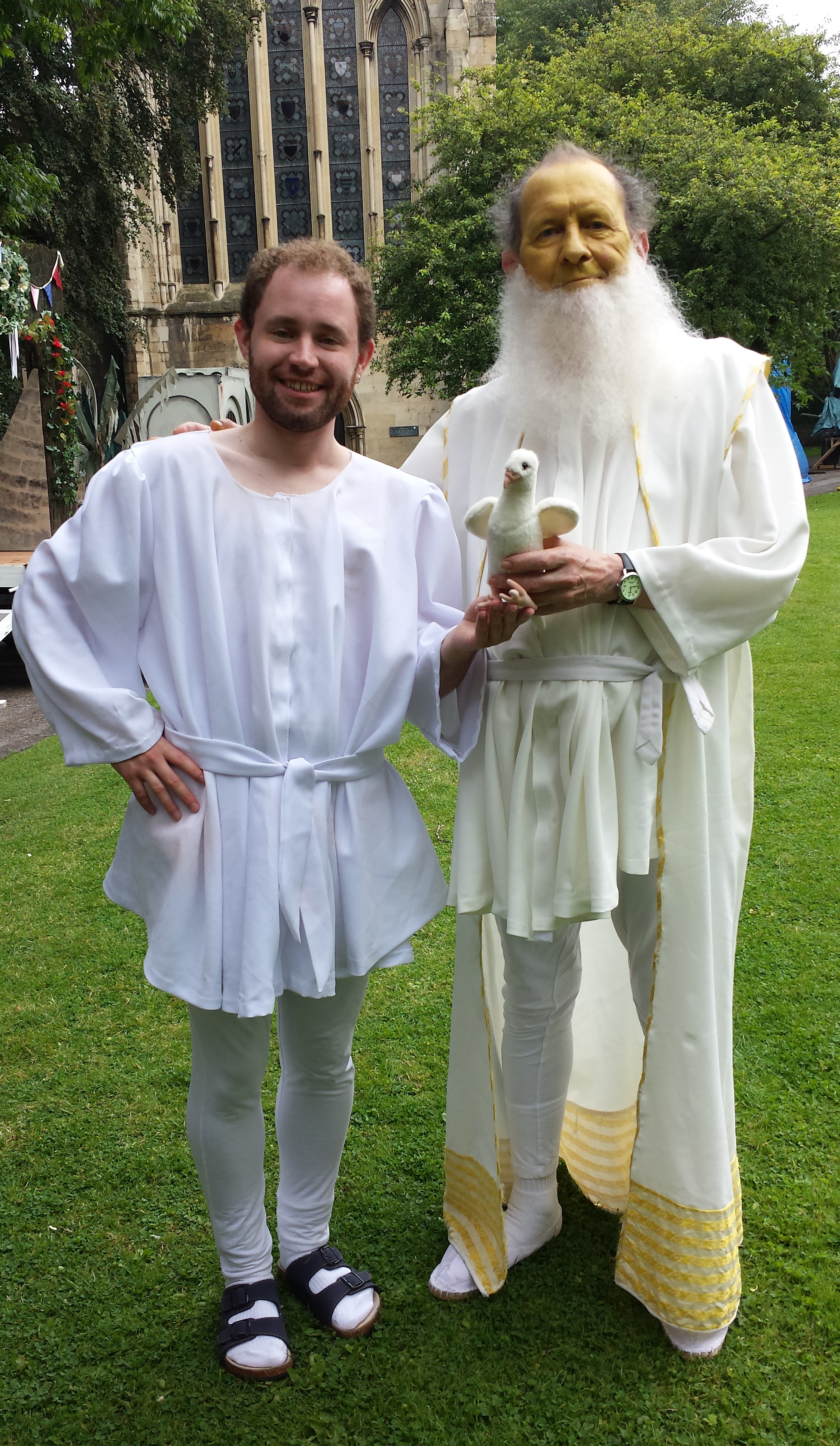
 We have exciting news! To our great delight, we’ve been asked to revive last summer’s production of The Baptism for the York Mystery Plays Conference on 1 August.

HIDden has always had a special connection with the Mystery Plays- it gave us our start. York’s plays are a unique event with a very long history, and it’s always an honour to be part of the community that continues to create new chapters of that story.

We’re also looking forward to reassembling the majority of our very talented cast! Mark Burghagen and Ehren Mierau will be reprising their roles as John the Baptist and Jesus, respectively. Our angels, James Wright and Kate Thomas, are returning. And our God, Charles Hunt, will be back in his heaven- all should be right with our world!

We can’t wait to get back on the waggon!

For more information on the conference, or to register, please visit: http://www.yorkmysteryplays.co.uk/2015-conference-1st-august-book/

THE LEEDS IMC: REFLECTIONS AND PREDICTIONS ON MEDIEVAL DRAMA


If you’ve been following us on Twitter (you do that, right?), you may have noticed a lot of recent tweets about “IMC2015” and rather more academic comments on medieval drama. That’s because last week was the Leeds International Medieval Congress, one of the two major international conferences for medievalists. It’s one of the highlights of my year, because one does not often get the chance to spend several days thoroughly buried in one’s pet subject, among like-minded people.


Despite the fact that I’ve mentioned medieval drama, you’d be justified in wondering why I’d go on about this to you. I think of it like this: we go to conferences so you don’t have to.


This is one of the ways we get the “information” that makes our plays “historically informed”. Although some of the issues discussed at a conference like this may seem highly abstruse, and you might never be able to point to a specific moment in a play and say, “There. That is how they used it”, everything that gets learned at a conference- or, maybe even better, every issue that is raised but remains unresolved- goes into the way that I think about the plays that I direct. Dramaturgy and academia are awfully similar, and any responsible director does their homework before tackling a new dramatic project. Of course, this is even more important in our case, because we couldn’t do a very good job of bringing history to the stage if we didn’t know what it was!


The other thing that I love about conferences like Leeds is the fact that they’re a chance to talk over ideas about historic drama with others who work on it, many of whom literally wrote the books on which this field is based. It is an absolutely lovely, incredibly supportive community, full of truly brilliant people. I don’t think I’ve ever left a conversation with any of them without having new insight, new questions, and above all a renewed ethusiasm for historic drama.


One of the issues which came up briefly that I want to explore more is the difference between ‘re-enactment’, ‘reconstruction’ and ‘revival’ in terms of staging medieval (or any historic) drama. The terms get used somewhat interchangeably, but I think they’re all very different. At HIDden, I think we live mostly in “revival” camp. We’re not necessarily trying to show you how things were (or may have been) in any of the time periods of our plays. And while we may be asking our own questions about what the demands of the text are, what staging options might work compared to what we know of the techniques and spaces available in the play’s original period, or how various styles of acting may have changed an audience’s understanding and engagement with the play, our ultimate goal is to give our audience something they can enjoy and appreciate. We want them to be able to find echoes of our stories in their own lives and experiences. HIDden always hopes to bring a play to life for the people who are seeing it, which invariably means making some compromises between the times and experiences of the play’s history and its situation in today’s world of performance and reception.


Another topic of discussion, which has been repeatedly cropping up at medieval drama gatherings lately, is what the future of the academic discipline might be. I’ll be talking about this again in the future, but to put on my hat of prognostication, I think that one of the ways forward will be more people looking at these plays who aren’t from the traditional disciplines of history and literature, and who might be from outside the formal academic community altogether. Performances that are divorced from academic institutions seem to be on the rise- like ours! The importance of the audience and its experience, both in academic study and in actual production, will continue to become more and more important. And modern- dare I say ‘revival’- productions will become an increasing focus of study in their own right. Those are just my guesses; we’ll have to wait and see if they come true.


One more “future” prediction which came up was that of interntional dialogue about the medieval dramas beyond Britain. Of course, those on the Continent are- and long have been- quite aware that they have extensive traditions of medieval performance. We here in Britain haven’t always paid as much attention to that, and I admit to being guilty of this myself; being monolingual is very limiting. While I’m not going to turn into a multilinguist, fortunately more and more of these European plays are being translated, and opening up these plays for those of us who are hobbled by language limitations. This makes these plays, many of which sound immensely interesting, potentially playable for British audiences, and I hope that someday we’ll have the chance to produce a few.


Now that the Leeds conference is over, of course, the immediate future, for me at least, is work and study. I’ll be returning to “The Vital Spark” and the Victorians, but I’ll be keeping these thoughts from the conference in my mind for the next medieval project.


Writer’s Notes: Introducing Jenny Hill, the ‘Vital Spark’  

For many the image of a woman performing stand-up comedy seems like a fairly modern phenomenon, especially when listening to the constantly reoccurring debate as to whether or not women are funny. With strict ideas about a womans place being ‘in the home’ and backlashes against platform women and the fight for Women’s suffrage, the Victorian music hall would certainly not look like an obvious timeframe in which to begin an exploration of Women’s history in comedy. However, the enormous success, earning power and interesting material of the female serio-comic on the music hall stage gives us a complex insight into our comedy history. Serio-comics were performers who produced a mix of comic and serious songs and sketches, interspersed with patter and audience interaction. They relied heavily on topical and satirical comic songs and their material can be seen as an embryonic form of the stand-up comedy we enjoy today. These serio-comics would perform their material on the music hall stage as part of a variety bill during which acts such as dancers, acrobats, scenes from ballets and operas and animal acts would perform to a largely working class audience.

One of the most famous of these serio-comics was Jenny Hill (1848-1896) – known as “The Vital Spark.” Hill’s career began when she was 7 and played the legs of the goose in mother goose! Her most notable solo serio-comic successes occurred between 1870 and 1894 and it was during this time that she became one of the highest paid performers on the British stage earning as much as £80 for twelve nights work as well as having regular benefits held in her honour. At these benefits she was presented with gifts such as diamond rings and broaches. She performed a rich variety of material, mainly focusing on representing the lives and work of working class women but also including highly political songs (one seeing her perform as a female politician), upper class male personation and drinking songs. Although the press at the time constantly tried to belittle her achievements her reputation, tireless self-promotion though advertising and immense success throughout the country make her an intriguing and exciting lens through which to revaluate music hall and women’s contribution to comedy and performance.

– Lola Wingrove, theatre historian and writer for The Vital Spark


The Vital Spark: A New Project

We’ve hinted at new things on the HIDden horizon. One of them is, on the surface, a big departure for us- but it’s very exciting. This is a new piece of drama, tentatively titled The Vital Spark. It’s the story of the life of Jenny Hill, the first woman to be recognised as a “comedienne”. Hill was a star of the late-Victorian music hall, who, like many performers since, combined humour, interesting characters, and a certain degree of social commentary.

Hill is the thesis subject of Lola Wingrove, a PhD candidate at the University of Bristol. I first heard Lola speak about women’s performance in music halls last year, and right away I knew there was a play in there waiting to happen. We chatted after her lecture about the idea of using her work on reviving Hill’s repertoire to create the basis for a play about the life of this remarkable Victorian performer. And now, in collaboration, we’re doing just that.

A new play… Victorians… on the surface, it’s quite different from what HIDden has done thus far. This project goes to the heart of our interests: a fascinating personality, and interesting story, and one that speaks to a specific aspect of the past, one that you might not know very well. Certainly it’s quite new to us! Moreover, it’s taking us all right back to the archives; there are no scripts left of Jenny Hill’s performances, and of course there is no film, so the challenge, to Lola as the writer and to the HIDden team in putting the production together, is to use original material to try to imagine what happened. As with our medieval productions, we know we’re not going to “authentically” “recreate” anything. What we’re hoping to do is to use the evidence that history has left us to create something new, something that will show you a bit of theatre history that you haven’t had the chance to see before.

Although we’re still in the early stages of this project, we’ve already learned quite a lot. In the weeks ahead we’ll have more interesting things to share with you: a bit about Jenny Hill and her life and times; the Victorian theatre; and just how we’re approaching the challenges of creating a new piece from historic documents. I can’t wait to see how it all comes together- it’s going to be an exciting journey!

Director’s Note: Changing Times

Over the past year, things at HIDden have changed somewhat. Our co-founder Suzanne Fatta has moved on to new projects (and is doing amazing things in Buffalo, New York). We’ve welcomed new faces- our producer, Ian Murphy, and production manager, Nathan Bargate, came on board following last year’s very successful ‘Baptism’ in York, and their work is helping to move HIDden forward in more ways than I can count.

But the change that will become the most apparent in weeks to come is that we are making an attempt to move out of the Middle Ages. We’ve always intended to look at drama from various time periods, and we’re really starting to do so. We’re also engaging more with newer works about the past.

This may seem like a bit of a departure for a company that has primarily produced medieval plays thus far, but it really isn’t. The HIDden team has always found drama to be an excellent window into stories of times gone by… and what time doesn’t have its interesting stories and characters? We don’t want to limit ourselves, or what we bring to our audiences. It’s a bit of a challenge to me personally, as a medieval drama specialist, because that’s my comfort zone, but I think we’re all enjoying the opportunities that a broader historical and dramatic perspective offers. It’s easy to get into a cosy niche and stay there, but it limits your ability to grow creatively, and that’s a huge part of what the arts are about. Broadening our horizons means we’ll be able to bring fresher eyes to any play we’re working on.

If you’re a medieval enthusiast, don’t worry, we won’t be leaving the Middle Ages entirely. At present, we’re working on some possible medieval merriment with the amazingly talented ladies of Timeline Songs, whose speciality is the music of the times. But we’re also developing a production with Lola Wingrove about late-Victorian working-class theatre, and we’re reading through some interesting new scripts from a variety of places and times. Broadening our horizons… bringing you more interesting productions… it’s all grist to this ever-engaging mill!

A Report From The Field: Medieval Drama at The Kalamazoo Conference

I’ve recently returned from my annual pilgrimage to the international medieval conference in Kalamazoo, Michigan: four days of talking shop with medieval drama scholars from various countries and different specialities. Medieval drama tends to be a pretty small field, so there’s always a certain element of reunion with friends to the conference.

One of the themes which seemed to keep popping to the surface this year was that of performance. The central question was, why is medieval drama so overlooked? As someone said, the ancient Greek dramas often make it to the stage, not to mention the obvious revivals of Shakespeare that proliferate across Britain (and everywhere else). But medieval plays have remained the province of small church groups or within academic halls. Why… and how do we find a way to break this paradigm?

The issues discussed would sound like a depressingly challenging, almost insurmountable litany, but it was actually very positive. There seems to be a subtle groundswell in favour of more productions, especially those that aren’t tied to a university course or department. This is where companies like HIDden come in. It’s always exciting to find that we are, in fact, part of a bigger movement, and in a position to really work toward a larger goal. We’ve always believed that historic plays should be seen, and can be enjoyed by a much wider audience than might be supposed. It was very encouraging to be among others who are thinking along the same lines.

Of course this is all regarding medieval drama specifically, which is just one era of many. But if one rather small corner of the historic drama picture is potentially moving out of the shadows, it means there is scope for other neglected gems from the past to come into the limelight. In short, it means that, in a wider context, we’re on the right track.

We’re living in exciting times with historic drama, and I for one feel quite lucky to be part of it all.

Mankind Auditions

Auditions this past weekend were great, but we still have a few parts to cast! We’ll be holding another round of auditions this Thursday, 22 January. They’ll be held in the Arts Complex on Woodland Road in Bristol from 2-6 p.m. Please email us for detailed information, readings, and to book an audition spot: auditions@hiddentheatre.com and see https://www.dropbox.com/sh/3amvuzl7g4n0qbx/AAAGjjnviSOaFXITUHdryZpja?dl=0 for the auditions information pack.

Upcoming Production: “Mankind” (Bristol, February 28th 2015)

HIDden Theatre will be staging the medieval morality play Mankind for the Bristol Centre for Medieval Studies Postgraduate Conference, ‘Rule and Recreation’ on 28 February, 2015.

This weekend we will be holding auditions for this upcoming production in Bristol. We’re looking for enthusiastic actors to participate. For details about auditions and readings, please see: https://www.dropbox.com/sh/3amvuzl7g4n0qbx/AAAGjjnviSOaFXITUHdryZpja?dl=0