Performance for Christmastime: The Nativity Play

With the holiday season upon us, our Artistic Director has been thinking about the ways that performance is so often linked to our celebratory traditions. So for the next few weeks she’ll be musing on the history and continuation of those events. While they may not be the kind of theatre we tend to work on at HIDden, who knows how their influence may be felt upon our own projects!

Among the many traditions of the Christmas season, there is one to bring either joy or dismay into the hearts of all involved, largely dependent upon their age and relationship to the event. This is the Nativity Play, a staple of primary and Sunday schools throughout Britain and, to a lesser extent, America. Young children get excited at the prospect of putting on a play; the adults may heave a sigh at the prospect of the cat-herding that will be involved, and grin and bear it for the delight that their offspring have in the process. From a professional or commercial standpoint it is a stretch to consider this holiday phenomenon “theatre”, but it is inarguably one of the most common performative traditions associated with the holidays – and, one suspects, the first occasion when many professional performers trod the boards! There is also a fairly good likelihood that their existence owes something to the medieval drama traditions of so many centuries earlier, and their sudden revival at the turn of the twentieth century.

Christmas play-making has an extensive history. Performance has always been part of the holidays, particularly at the royal courts. Perhaps surprisingly, these were generally not the religious story of the Nativity. They were also performed for and by the adults, but we do well to remember that children were treated as mini-adults, without particularly special consideration, until the Victorians came along. One might therefore guess that it would be the nineteenth century which created the nativity play as we know it today, but thus far I’ve found no evidence of them until the early twentieth century. Possibly this is owing to the Victorian wariness about showing the deity on stage, an issue still effectively legally curtailed until the 1950s. The Victorians tended to hold sacred things as precisely that, and the idea of entrusting their performance to children would likely have been met with a cold reception, if the idea of performing holy things was even seriously considered.

The beginning of the twentieth century brought on a new interest in reviving medieval drama on the professional level (William Poel’s 1901 Everyman leading the way), and a general trend towards religious drama on the whole followed in its wake. Perhaps unsurprisingly, one of the first modern religious plays to be performed after it was about the Nativity. Dramas of faith began to proliferate, and church groups had an advantage when it came to staging them: as private organisations, they were exempt from the censorship laws. Another factor which probably fed the development of nativity plays was the fashionable pageant, a large-scale community spectacle which was popular during precisely the same time. Both children and adults were frequently involved in these events, which usually presented episodes of local history in a chronological progression. In fact, performing as a serious hobby seems to have been very much a part of life in those pre-television years, with drama groups of all sorts springing up across Great Britain.

By the mid-1920s, scripts for Nativity plays which were not dependent upon a medieval antecedent were beginning to emerge. These weren’t necessarily for children – when they became the province of the young remains elusive, although it seems possible that the disruption of World War II, and the quickened pace of life which followed it, may be a turning point in that direction. Certainly it makes sense that Christmas should be the particular occasion for drama: its purely festive atmosphere lends itself to play making in a way that is not true of Easter (inevitably accompanied by the sombreness of Good Friday). Moreover, family members are more likely to turn out if one of their children is in the play, making it a good chance to re-engage with those who aren’t normally involved in the church community otherwise. And it’s a story which, even if somewhat anarchic due to the very young age of participants, will still be sufficiently familiar to the audience.

Given its ubiquity, it might be expected that the nativity play would be the product of a long and richly documented history, but one of the interesting aspects of considering its history is the way that it reflects a common problem among theatre history studies. By virtue of being a true “folk” play, something put together by ordinary people among their own, for their own small community, it remains largely undocumented. The folk plays of medieval England are almost entirely lost to us; so it seems likely to be with the nativity play in the future. There are innumerable events every winter, yet practically no trace of them after the fact. Seemingly eternal yet ultimately elusive – perhaps this renders them a good metaphor for both the childhood which is so much at their heart, and the truths of faith which are their theme.

In Memoriam: Remembering Charles Hunt

Theatre can be a strange social world. As often as not, due to the off-kilter hours, the particular demands, and the immense dedication it takes, it becomes one’s life, not just one’s work. Friends within that world matter especially, because they understand it. But friendships within theatre are also sometimes peculiar. It creates intimacy rapidly, but its usually transient nature means that those friendships frequently don’t remain close. The ones that do manage to stick, however, become precious. So the loss of those people is keenly felt.

On the morning when we were waking up for the day of the Mankind performance, we were greeted with the sad news of the death of Charles Hunt, an actor with whom the HIDden team has worked for several shows. We were looking forward to seeing him at the performance, and so it came as quite a shock. Our last communications were his offer to loan us costumes if we needed them, and his good wishes for the show; which he hoped to attend. That, right there, summed up Charles. He was always supportive, always encouraging, and enthusiastic about medieval drama in a way that is somewhat uncommon outside of the academic community.

The comments which poured onto his Facebook page, maintained by his family, all seemed to speak of the two most profound qualities with which we too remember him: Charles was a true gentleman, and a devoted theatre person. It always seemed fitting that, at Christmastime, he annually portrayed Charles Dickens for evenings of dramatic readings; for Charles was the modern-day embodiment of the courtly Victorian Gentleman: a soft-spoken, kindly individual, who carried himself with a quiet grace.

We first met him as an actor who played Joseph in our London debut production. While the Nativity play we had chosen did not include the comical Joseph’s trouble about Mary, there’s no doubt he could have handled it. Charles had a good sense of the comic turn, but was also totally convincing as the protective and devoted Joseph who would be the infant Jesus’ Earthly father figure. When The Baptism came around in 2014, the decision to include God had already been made, and he was really our only choice for the part.

Our Artistic Director, Laura Elizabeth Rice, notes:

From a director’s standpoint, Charles was delightful to work with because he always had ideas and suggestions, but he wasn’t a backseat driver. He’d mention them after rehearsal, and if you wanted to try them out, he was happy to do so; if they didn’t fit in with a production, he didn’t push the matter. You could also always count on him to try what was asked and to be enthusiastic about any new project. When I remember him it will always be with the gentle smile he bestowed upon Jesus as he blessed him from Heaven in The Baptism.

The sense of history and performance that turned him into a remarkable impersonation of Charles Dickens every winter is probably what made Charles such a good fit with HIDden, but he also seemed to believe in supporting young companies as they found their way forward; in this respect we are not the only ones indebted to his kindness. It meant a lot that someone well established in the local theatre community shared our idea that the past is a rich field to mine for performance in the present.

Charles was that friend in theatre who stayed – a true character of the theatre, a fantastic actor, and an unconditional source of support – we will miss him very much.

Director’s Notes: Wrapping Up “Mankind”

Finishing up a show is always a mixture of feelings. Accomplishment. Pride. Exhaustion. And the process of looking back and analysing what went well, and what lessons were learned along the way.

Mankind had numerous highlights. A few weeks ago we noted some along the way, as they’d manifested thus far in the rehearsal process. Many of them carried through to the end. The absolute commitment and enthusiasm of the cast comes in first for mention, as it was both unwavering and crucial to the play’s success. Medieval plays can be hard going for actors: the wording is unusual or foreign, there are lots of long monologues, it’s not always evident what is happening. Our cast did a brilliant job of overcoming any confusion, and the progress with which they learned their lines and characters was remarkable. Every single rehearsal we saw improvement, and their best performance was the one in front of an audience- just what you want to have happen! I’m still in awe of how quickly they assimilated changes and adjustments: these were amateur actors and for the most part they did this as well or even better than many professionals. They brought ideas and tried them out, remained flexible in their thinking, and managed to make it look as if they hadn’t been working flat out for weeks. I really couldn’t be more proud of them.

I also just plain liked our cast as people. It often seems to me that the theatre attracts an unusually high number of interesting, intelligent, kind, generous, and dedicated people. Maybe that’s just the nature of the thing. But it makes work that much more enjoyable. Theatre friendships can be funny- because you all go on immediately to other things, people often don’t stay in touch, but whether we do or not, I consider myself fortunate for having had these people’s lives and work collide with mine, even for a short period of time.

We asked the audience for feedback, as we are in a process of determining where to move forward as a company. Their reception of Mankind was beyond my expectations. I’m especially pleased with the comments from those who don’t know medieval drama and who had come along warily, and were surprised by how accessible and engaging it is. That is exactly why we do this: to share the past in ways that surprise and delight. Any time someone says they learned something new- especially if that something is how interesting historic drama is- I feel like we’ve had a success.

In short, Mankind was everything we’d hoped it could be. If you didn’t have a chance to see it… It’s the kind of play I could certainly keep coming back to. Who knows? Maybe someday it will have another incarnation. And if it does, I can only hope it will be as much fun as this version was to create.

Updating the Style, Keeping the Substance

Translating an archaic script, as previously discussed, is time consuming and requires a bit of effort, but it’s not terribly difficult. The translation that does become a challenge is finding modern idioms, of cultural elements, that are analogous to those appearing in a historic script. The meaning needs to be similar, but the issues that resonate in one period often don’t a few centuries later.

Mankind presents this most particularly in the scene where the Vices try to re-style his jacket into something more up-to-date. Making him an absurdly short coat is only mildly funny today: unless you spend a lot of time on historic costume, you probably won’t realise that ultra-short jackets were the cutting edge of trendiness in the late fifteenth century. For men, the more wealthy and ostentatiously stylish you were, the shorter your jacket was. The trend-setters of the day would have been the younger gentlemen of the court, some of whom may not have come from old, well-established families, and who would be anxious to prove that they could fit in- what might snobbishly be referred to as “new money” today. The playwright of Mankind was parodying both the short style of coats, and also the sort of men who might wear them.

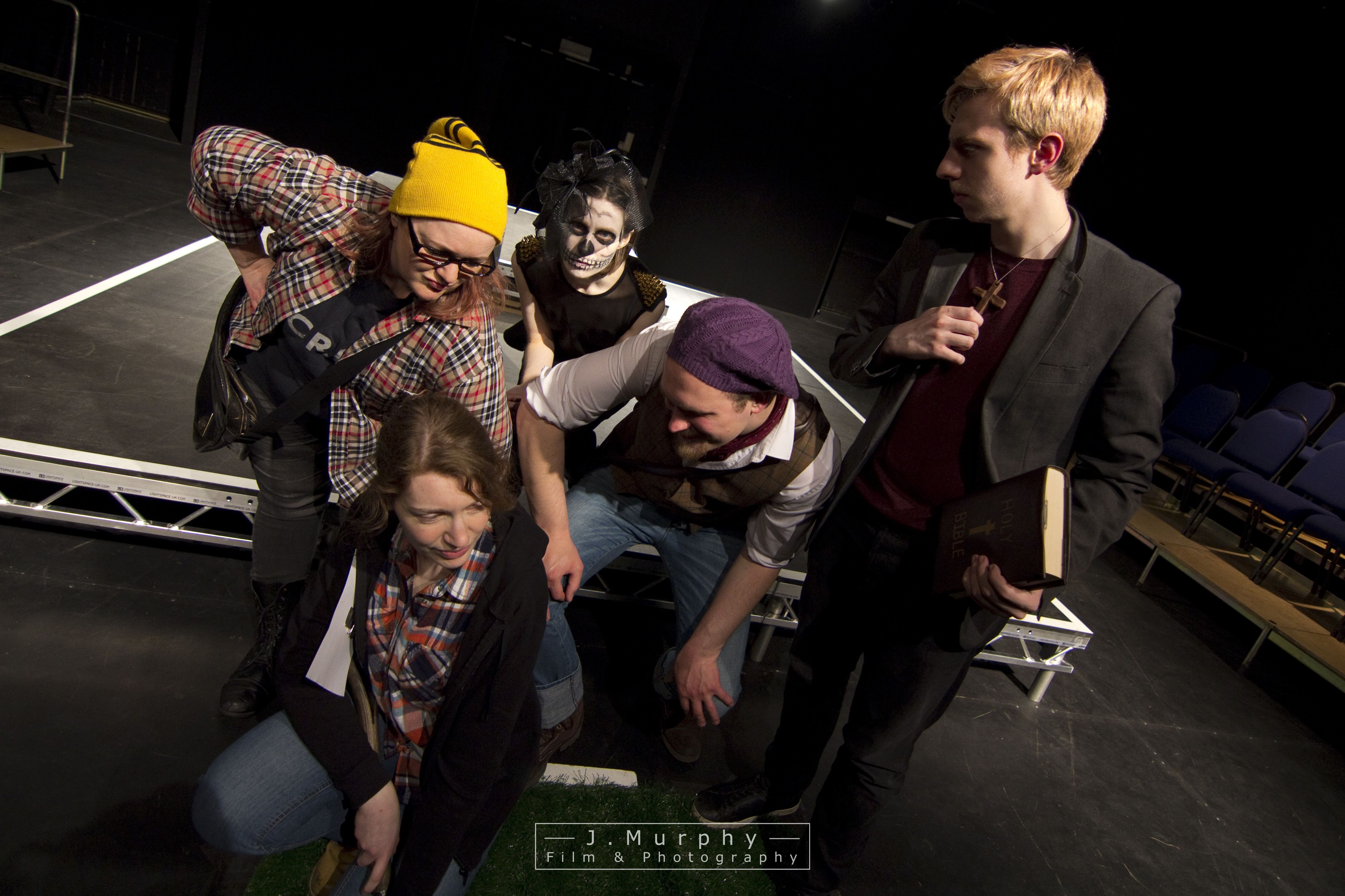
Simply cutting up Mankind’s coat doesn’t mean as much today, though, so we looked for an analogous stylistic language. What is considered trendy today, that might also be singled out for a bit of gentle teasing? What symbolises youth and ambition? Thus were born the hipster Vices. “Hipster” may be a bit difficult to define, but it’s written about as a subculture of young, relatively affluent people who consider themselves nonconformists (but are often noted to do so in the same way as one another), and are criticised for being pretentious; they strive to have a down-market, vintage look but have no aversion to the newest technology.

We didn’t choose this style to be critical of those who embrace it, but because it seemed a good, easily identifiable modern analogy to the ostentatiously trend-setting courtiers of the late medieval period, something that is sufficiently established as a culture/style but also comes in for castigation by others. It also seems to be defined from the outside: not many whom others might consider “hipsters” would self-identify as such, rather like Nought, who worries that he “might well be called a fop”, when clearly he is something of a dandy. And because the hipster style is quite identifiable, it seems likely that it will end up being very dated and of our particular era, much like the short jackets of the era in which Mankind was written.


There are always some imperfections in trying to update a concept which is particularly tied to a time and place, but we think that this one makes a lot of sense. It helps ground Mankind in the world of today as much as that of the past, reminding us that people don’t really change that much, and the world of the Middle Ages is not entirely unlike our own.


Director’s Notes: Mankind: First Rehearsals  


Mankind is approaching swiftly, and all of us at HIDden are running about making sure things are in order. The weeks leading up to a production are always exciting, and busy, but I wanted to take a moment to reflect on some of the more delightful aspects of our process thus far. It’s a snapshot of a bit of our “behind the scenes” life. Here are a few of my favourite moments:

  • While everyone works on Latin pronunciation, during blocking rehearsals we all just shout “Latin!” where a big chunk of it is in the script.
  • Trying out lots of different characterisations for Titivillus- because demons can be just about anyone.
  • Those moments where actors you’ve worked with before manage to take their work to a new level and surprise you with an even better performance than expected.
  • Getting to know and witness the incredible talents of new (and personally very lovely!) people.
  • When, as the director, I’ve read a line so many times and yet an actor comes in and reads it with a totally new delivery, and it brings out extra layers of meaning I hadn’t imagined.
  • Falling back in love with the play. By the time we hit rehearsals I’ve read it so often it’s lost a lot of its freshness, but as soon as it’s in the hands of the actors, I remember all the reasons I loved it in the first place.
  • That instant where I know that an actor understands their character perfectly and is bringing it to life in all the subtle and colourful ways that make it real.
  • Watching the cast bond. You always wonder, “Will this group work well together? Will they be able to support and challenge one another?” It’s always exciting to see that come into being.
  • Being constantly impressed by how quickly the actors weave little adjustments and ideas into their characters, and how it instantly clarifies things.
  • Group enthusiasm. Everyone’s been off learning lines and thinking about their characters; the energy of getting everyone in one room and starting to put it together is always special.
  • The surprise that comes when we hit the somewhat more bawdy parts of the play. Not all the actors had realised that medieval plays could be quite so “colourful”!

There is much left to do, but everyone is working really hard, and I think we’re all enjoying the process. I can’t wait to see what the next week will bring- and I hope you’ll join us at the performance, because all the signs thus far are pointing to a really great production!

How It Translates, Our Artistic Director’s Approach

When people find out that I’m working on a medieval play, almost always the first question is, “Are you doing it in modern or Middle English?” These days the answer is almost always modern, because despite enjoying it myself, I’ve come to recognise that Middle English is really challenging for audiences, and, unfortunately, often cuts them off from really getting to grips with the play they’re seeing. The next question tends, from academics, to be “Which edition did you use?”, and from non-academics, “How did you translate it?”

Despite how different it looks on the page, Middle English is not actually that difficult to get your head or tongue around. In fact, sounding words out aloud, the way kids learn to read, is a good way to make sense of it on occasion; the spellings will be peculiar, but once you hear it spoken, you’ll usually know what it means. So I’m never entirely sure that it’s really a “translation” proper. But, if you’ve been curious, here is how it happens.

First I go through the script and change any archaic letters into their modern equivalent. (For example: something that looks rather like the modern lower-case “y” is actually a “th”- it’s where we get “ye olde” from; it would have been pronounced as “the”.) Then I change all the really obvious words into modern spelling, which will usually be about three quarters of the text. Next come the words that are definitely in Middle English but whose meanings I have come to know over the years of working with it. I usually spend the better part of a day with a thesaurus, trying to find the closest word in meaning and colour, that also keeps any rhyme schemes and meters that might be present. About half the time, I can find a good translation that keeps the poetry and alliteration intact. When I can’t, I have to make some executive decisions. Will the audience make sense of an unfamiliar word from the context? How important is that particular word, or is the primary meaning conveyed elsewhere in the line? In some instances, I’ll leave the Middle English word in, feeling pretty sure that it won’t be detrimental to conveying the story or characters. In others, I’ll have to make the decision to disturb the carefully wrought meter or alliteration for the sake of clarity.

The biggest challenge is tracking down the words that I don’t know. Middle English can be difficult to look up (absent having a university library’s resources at your fingertips, and I usually work at home) because the spellings are so capricious; in some cases the word’s definition might actually be speculative and uncertain, and in others there might have been a clerical error which muddles the picture. There’ll usually be one or two that completely stymie me, which warrants a call to medievalist friends to pick their brains. In the end, it’s pretty rare not to track down some idea of what a word should mean. With that done, I repeat the process of trying to decide if I can keep the ancient word, or wrestling through trying to find an appropriate substitute if I can’t.

Invariably, there will be a bit of Latin. This is one area where I suffer as a medievalist: my Latin is virtually non-existent. That’s more time with dictionaries, Latin translation webpages, and usually some phone calls to colleagues who don’t mind helping me with tricky bits. (The up side to this is that I’ve picked up a bit more of the language than I would probably know otherwise.)

Only when I’ve got it pretty much solidified will I pull the editions off the shelf. My purpose in doing so is simply self-editing: I want to check that I haven’t misunderstood anything, that their glosses on words match my translations. I always look at as many as I have or can get my hands on, because sometimes they don’t agree on specific words, and sometimes one will have a more precise meaning that I need to contemplate. A lot of editions will also have commentary on parts of the play, which might clue me in about why a particular scene is written in a specific way.

It’s only after the script has been brought into the twentieth century that I start contemplating any necessary changes or cuts. I know that to some people this is anathema, and it may seem to go against my earlier assertion to trust the text with which I’m working. That trust doesn’t mean a play is perfect, though, or that as it has come down to us it is perfect for what we’re doing. It does mean, however, that I can tell you exactly why I’m changing things, and how I’ve done it; I don’t just go in and start chopping. Our rearrangement of the Vices in our current production of Mankind is a good example of this: it may be unorthodox, but I think that it helps make the play a little bit neater for this production. (If “re-creation” or “authenticity” were our intent, I would not have made that sort of change.)

Translating is a rather tedious and fiddly process, but it has the definite benefit that, while I may not have it memorised, I do know the script really well by the time we get into rehearsals, not just conceptually, but in a structural sense, how it is put together as well as what it is saying. And it’s easier to sort out any confusion the actors have with what is still a pre-modern verse piece. In the end, we have a script I’m happy with, which stays fairly close to the original.

Mischief… and Death

Of all the characters in Mankind, Mischief is the most elusive and enigmatic. Mankind and Mercy are human, Titivillus is demonic, and whether we read the N’s as demons or human who personify worldly evils, their role as vices is apparent. Mischief is not really a vice, a demon, or a person, but inhabits some world between: his presence bodes ill for Mankind, but ‘mischief’ as a concept is not tempting in the same way as the worldly indulgences promoted by the N’s.

For our Mischief we have relied heavily on a brief note in ‘Aspects of the Staging of Mankind’ by Neville Denny (in Medium Aevum, 1 January, 1974, p. 252-263). Denny equates Mischief with “ ‘calamity’, ‘disaster’, and hence with despair as well as malice”, and finally makes the suggestion that perhaps Mischief was staged as Death- a Grim Reaper, possibly as part of a lingering tradition from folk plays. While I can’t claim that this idea hasn’t been used in previous productions, I haven’t seen it with this staging, and thought it an interesting idea to consider.

A return to the script with this idea in mind gave me arguments both for and against this interpretation of Mischief. The greatest “against” is the cynical comedy and, well, liveliness of Mischief. One has a hard time picturing a cowled and scythe-carrying Death capering about and teasing the vices in this manner. Perhaps of greater weight is a discrepancy which is not limited to this play but a seeming contradiction that has often puzzled me. Mankind is, in its totality, an exhortation towards Christianity and its teachings of redemption: why, if one holds such faith, should Death be an antagonistic or fearful figure?

To both arguments I can offer rebuttals. Faith is seldom absolute; the fact that it is faith, rather than fact, means that death, for all the hope that faith is intended to offer, remains the great unknown, and inherently frightening. Moreover, in the late fifteenth century, death was a frequent and familiar visitor. This is post-plague Britain; and while the first and most horrifying outbreak was more than a century in the past by the time Mankind was written, an outbreak in 1471, nearly contemporaneous to the play, had taken out another 10% of the population. Death as calamity and disaster would have been all too easy an idea to grasp. And ‘Death’ should perhaps not be seen as a single entity: a Death which arrives when one has been behaving as Mankind does with the Vices is to be feared, whereas a Death which arrives when one is a more holy state of being might be a benevolent figure. Nor is a lively Death an anomaly to a fifteenth-century audience, for this is the era of the Dance of Death, itself an artistic allegory of the end of the life for all. While not exactly comical, it certainly refutes our modern idea of the Grim Reaper as a silent, staid, lurking figure.

What tipped me over into trying the idea of Mischief as a death figure was simply reading his lines with that in mind. To many of them it makes no difference, but to many it creates a much more interesting layer of interpretation. “I am worse than nought,” he laments, “I, Mischief, was here at the beginning of the game and argued with Mercy….” Death is, of course, the final “nought” of unbeing, and has been present not merely since the beginning of the play, but since the beginning of creation. Mischief’s threats to cut off the injured body parts of the Vices becomes far more sinister when one considers the survival rates for amputation in the era of medieval medicine, and his encounter with the law (“the chains I burst asunder, and killed the jailer, yes, and his fair wife embraced in a corner”) certainly takes on a different hue if he also personifies the end of life.

Mischief as death makes sense of his difference from the N’s, as Denny suggests, as well as adding a nice layer of darkness to the scatological levity of the Vices, and raising the stakes on Mankind’s behaviour. It also makes Mercy’s gesture of compassion something beyond a theological salvation. Perhaps, knowing what is really at stake through his encounter with a Mischief who offers him an unforgiven mortality, Mankind will think twice before spending more time in the company of the Vices.

Director’s Notes: The Fiction Behind Mankind

On these posts I try to give you some insights into the plays we’re working on- the backstory, the history that informs our work, and the occasional behind the scenes “here’s how we we’re doing it and why” perspective. This might give you the idea that the HIDden approach is a very academic, as well as theatrical one. There’s a fair bit of truth in that, but I don’t want you to think that everything is ultra-erudite or heavy going. Sometimes, the things that inspire us or make things click into place don’t have footnotes, and that’s what I wanted to share today.

Every time I am faced with medieval characters whose primary definition is “being a medieval peasant”, there is a book I grab off the shelf. It’s fiction- well informed, heavily researched fiction, but the point isn’t that it’s true or not, but that it speaks to something evocative that sometimes historical documents can’t reach. The book is called Down the Common, by Anne Baer, and almost twenty years after I first read it, I still absolutely love it for its non-romanticised, down-to-earth story of life in a medieval village. And it’s the first thing I will turn back to when working on the character of Mankind.

The people in the story are ordinary: some are more clever or introspective (Mankind might have understood them) and some are foolish; some are looking for adventures and some never want to leave their patch of earth. All of them are engaged in the everyday struggle to keep body and soul together: getting in the harvest, surviving the cold of winter, bringing up children who know how to behave in ways that won’t be destructive to the community. Their lives are in so many ways completely different from ours, but the getting on with every day is what most of us do today, too.

I think about those fictional peasants when I try to imagine Mankind’s life on an ordinary day, when maybe he hasn’t just heard a sermon in church and isn’t quite so anxious about the state of his soul. After all, despite his initial self-abasing monologue, we also see him carrying in with the plowing and planting of his fields, so we can assume that he does not spend all of his time bemoaning the state of his everlasting soul! It’s also easy, though, in reading this tale of the struggle of medieval peasantry, to see why someone like Mankind might yearn to achieve whatever behaviour will earn him a place in a heavenly afterlife. Their bodily existence is not one we modern folk would consider pleasant.

But neither are their lives unrelieved misery, which is something we may forget if we think of the Monty Python mud-peasants when we picture everyday medieval life. The Vices are the extreme end of the spectrum, but to use Mercy’s favourite word, within measure they represent the amusements- singing, dancing, joking, drinking, festivals, celebrations. The other thing I love in Down the Common is the delight people find in little things that today we would probably overlook. A sunny day means more. Freshly baked bread is a genuine treat. Someone like Mankind, clearly of a naturally spiritual turn, might find God in those moments- and perhaps he will value those things more, now that he knows what excess can bring.

I can’t tell you what will be in an actor’s head when playing the character (nor should I try!), but in directing it, the world created in that book is in the back of mine. It’s also just a really good read, and I recommend it to anyone, especially if you’ve ever wondered what’s going on way, way behind the scenes in “director brain” during the process of putting together Mankind.

How Many Vices?

The “imbalance” of good and evil figures in Mankind is something often noted in academic writing about the play. There are five villainous characters to the sole virtuous figure of Mercy, and given that Mercy does tend to embody some of the issues of which the others make fun, the actor playing him has a tough row to hoe, if Mercy is somehow to come out as a balance to the others.

The other difficulty, though, which is also well noted, is that the three N’s are relatively indistinct. It could be argued that they are an inversion of the holy trinity: three bodies with one essential being, and I think this is the likely reason why there are in fact three of them. But not all theological intention translates perfectly to the stage. If, in fact, the Vices were completely indistinguishable, this feature of the play might be more successful. There are, however, three ‘N’s’ but two characters. Nought stands apart as the “lesser” of the group, the one who is mocked by the others, who seems the most bumbling; Nought also says less than his fellows. Meanwhile, New-Guise and Nowadays are almost impossible to tell apart.

We’ve thrown various ideas around for different ways to work on this issue, most of which are concepts added on; the text just doesn’t support much obvious distinction between them. And somewhere along the way, someone asked, “Did these parts used to be one character?”

There is no evidence to suggest that Mankind had a previous incarnation with only two Vices. I want to state that very clearly. But looking beyond Mankind specifically, plays do get changed, often in terms of character numbers. I daresay it’s less common in the professional world (though I recall seeing a production of Hamlet years ago where the character had been split into three, so it does happen), but certainly in amateur theatre, parts are often split up, or new ones created, if there is a desire to have greater participation. The general consensus is that Mankind was not an amateur production, but a product of the early days of professional, touring theatre troupes in England. And yet it is generally understood that the parts of Titivillus and Mercy can be played by the same actor- and, presumably, can be played by different actors, depending on cast numbers. So while the N’s might not be where Mankind has demonstrable flexibility, there is at least some degree of it built into the play.

So… what would happen if the two indistinct characters were simply rolled into one? Having had the question raised, we decided to play with it. As far as the script goes, the answer is “relatively little”. Because of the patterns with which the three Vice characters speak, it’s quite easy to reassign most of Nowadays’ lines to New-Guise. In a few- perhaps five- cases they work better if shifted to Nought. And it ends up strengthening both remaining Vices as discreet individuals. It also cuts down, at least slightly, the numerical opposition to Mercy.

Auditions, as the first occasion of seeing actors’ spin on parts, sometimes give you brand new ideas. Sometimes they come in to read for a part and have an interpretation that you haven’t thought of, but that makes so much sense as to make you rethink the character altogether. (And this is the collaborative phenomenon that makes theatre so engaging.) We wanted to take that chance… and we saw really good people read. But we didn’t see New-Guise and Nowadays emerge in great difference, which confirmed the feeling that the two characters are just not unique. That’s not a failing in any of the actors who read the parts; it may be argued that it’s a failure on the part of the writer (though neither he nor contemporary audiences likely didn’t see it as important; these are, after all, broad allegorical types). Actors create a role, but they shouldn’t stray completely out of what the text offers them; if the text doesn’t offer anything, it’s fair to wonder if there isn’t a different way to do things.

The result is that we’re being a bit non-traditional in our Mankind, which was never intended to be an attempt at re-creation anyway. We’re going to try to see how the play changes if the redundant characters are merged, and hope that it gives the actors playing the Vices more to sink their teeth into, which in turn translates into more dynamic performances, and a play that’s just that much more entertaining.