A Farce Bibliography, Part 1

If you’re wondering what we’ve read behind the scenes for the French farces and for our #FarcesFriday writings, here’s the first part of the director’s bibliography.

I went into this project knowing extremely little about farce from any era, so this is a longer reading list than usual (and it actually isn’t totally comprehensive; many other things were read as well). I don’t assume you’d ever want to read quite this much about them- though I hope you’ll find something that intrigues you!- so I’ve put asterisks by those titles which were particularly helpful. I’d especially like to highlight the wonderful anthologies by Jody Enders, which even the most casual reader will find entertaining rather than academic, though they have a deeply erudite foundation. They were the inspiration for this project, and while we have taken a different approach to adapting and translating the plays, they show a unique approach to bringing plays which were very much a reflection of their own time, into our own era. On to the books…..

Arden, Heather. Fools’ Plays. (1980) Cambridge University Press: Cambridge.

Badawi, Abdurrahman. “Influences Islamiques sur la littérature française a l’époque classique”, Studia Islamica, No. 45 (1977), pp. 5-25.

Bazin, François Emmanuel Joseph. Matire Pathelin, opéra comique en un acte. (1879) Léon Escudier: Paris.

Beam, Sara. Laughing Matters. (2007) Cornell University Press: Ithaca & London.

Beck, Jonathan. Théatre et propagande aux débuts de la Réforme. (1986) Editions Slatkine: Geneva, Paris. 

Bentley, Eric. The Life of The Drama. (1964) Applause Theatre Books: NY.

Bermel, Albert. Farce: a History from Aristophanes to Woody Allen. (1990) Southern Illinois University Press: Carbondale & Edwardsville.

Bloch, Marc. French Rural History. (1966) University of California Press: Berkeley & Los Angeles.

Bloch, R. Howard. “Medieval Misogyny”, Representations, No. 20 (1987), pp. 1-24

Bowen, Barbara C. “Metaphorical Obscenity in French Farce, 1460-1560”, Comparative Drama, 1977, pp. 331-344.

Brown, Arthur. “Folklore Elements in the Medieval Drama”, Folklore, Vol. 63 No. 2, (1952), pp. 65-78.

Brun, Laurent. “French Studies: Late Medieval Literature”, The Year’s Work in Modern Language Studies, Vol. 76 (2016), pp. 14-34.

Campbell, Josie P. “Farce as Function in the Wakefield Shepherds’ Plays”, The Chaucer Review Vol. 14 No. 4 (1980), pp. 336-343.

Cannings, Barbara. “Towards a Definition of Farces as a Literary ‘Genre’”, The Modern Language Review, Vol. 56 No. 4 (1961), pp. 558-560.

Caputi, Anthony. Buffo: the Genius of Vulgar Comedy. (1978) Wayne State Detroit Press: Detroit.

Cazalas, E. “Où et Quand se Passe l’Action de ‘Maistre Pierre Pathelin’?”, Romania Vol. 57 No. 228 (1931), pp. 573-577.

Chase, Carol J. & Marie-Sol Ortolá. “The Ideology of Deception in ‘La Farce de Maistre Pathelin'”, Modern Language Studies, Vol. 16 No. 3 (1986), pp. 134-148.

Chevaldin, L.E. Les jargons de la farce de Pathelin. (1903) A. Fontemoing: Paris.

Conroy, Peter. “Old and New in French Medieval Farce”, Romance Notes, Vol. 13 No. 2 (1971), pp. 336-343.

Cons, Louis. “L’Auteur de la Farce de Maistre Pathelin”, Revue du Seizième siècle, (1913), pp. 473-476.

Cons, Louis. “L’ L’Auteur de la Farce de Maistre Pathelin”. (1926) Princeton University Press: Princeton, New Jersey.

Crist, Larry S. “Pathelinian Semiotics: Elements for an Analysis of ‘Maistre Pierre Pathelin'”, L’Esprit Créaeur, Vol. 18 No. 3, (1978), pp. 69-81.

Cunningham, W.R. “The Date of the ‘Cent Nouvelles Nouvelles'”, Modern Language Review, Vol. 38 No. 3 (p. 250).

Dane, Joseph. Res/Verba. (1985) Brill: Leiden.

Davidson, Clifford, ed. Fools and Folly. (1996) medieval Institute Publications: Kalamazoo, MI.

*** Davis, Jessica Milner. Farce. 2003) Transaction: New Brunswick, NJ.

Davis, Natalie Zemon. Society & Culture in Early Modern France. (1975) Stanford University Press: Stanford, CA.

Dean, Joan F. “Joe Orton and the Redefinition of Farce”, Theatre Journal, Vol. 34 No. 4 (1982), pp. 481-492.

Devereux, George. “Ethnopsychological Aspects of the Terms ‘Deaf’ or ‘Dumb'”, Anthropological Quarterly, Vol. 37 No. 2 (1964).

Diller, Hans-Jurgen. “Laughter in Medieval English Drama: a Critique of Modernizing & Historical Analyses”, Comparative Drama, Vol. 36 No. 1/2 (2002), pp. 1-19.

Droz, E. “L’Illustration des Premières Éditions Parisiennes de la Farce de Pathelin”, Humanisme et Renaissance, 1 No. 1/4 (1934), pp. 145-150.

Dunn, E. Catherine. “The Farced Epistle as Dramatic Form in the Twelfth Century Renaissance”, Comparative Drama(1995), pp. 363-381.

Dutton, Kenneth R. “Farce/Farts: Divergent Styles of Comedy in Medieval France.” Stylistyka, Vol. 10 (2005), pp. 351-361.

Enders, Jody. “Allegory Plays”, Studies in English Literature Vol. 55 No. 2 (2015), pp. 447-464.

*** Enders, Jody. The Farce of the Fart & Other Ribaldries. (2011) University of Pennsylvania Press: Philadelphia.

*** Enders, Jody. Holy Deadlock. (2017) University of Pennsylvania Press: Philadelphia.

*** Enders, Jody. Immaculate Deception. (2022) University of Pennsylvania Press: Philadelphia.

*** Enders, Jody. Trial by Farce. (2023) University of Michigan Press: Ann Arbor.

Evans, Joan. Life in Medieval France. (1989) Lonsdale & Bartholomew Ltd: Leicester.

Famiglietti, R.C. Tales of the Marriage Bed from Medieval France (1300-1500). (1992) Picardy Press: Providence, RI.

Field, W.H.F. “The Picard Origin of the Name ‘Pathelin'”, Modern Philology, Vol. 65, No. 4 (1968), pp. 362-365.

Frank, Grace. The Medieval French Drama. (1954) Clarendon Press: Oxford.

Frank, Grace. “Pathelin”, Modern Language Notes, Vol. 56 No. 1 (1941), pp. 42-47.

Frappier, Jean & A.M. Gossart. Le Theatre Comique au Moyen Age. (1935) Larousse: Paris.

Ganderax, Louis. “Revue Dramatique”, Revue des Deux Mondes (1829-1971), Vol. 46 No. 3 (1881), pp. 694-704.

Guynn, Noah D. “A Justice to Come: The Role of Ethics in la Farce de Maistre Pierre Pathelin”, Theatre Survey, pp. 13-31.

Guynn, Noah D. Pure Filth: Ethics, Politics, & Religion in Early French Farce. (2020) University of Pennsylvania Press: Philadelphia.

Haug, Hélène. “‘Maistre Pierre de Hurion, Agille Imitateur’: Bilan sur les Auteurs Actifs á la Cour de René d’Anjou (1434-1480)”, Romania, Vol. 131 No. 521 (2013), pp. 130-151.

*** Harvey, Howard Graham. The Theatre of the Basoche. (1969) Harvard University Press: NY

Holbrook, Richard. Etude sur Pathelin. (1965), Elliott Monographs, reprint by Kraus Reprint Corporation: NY.

Holbrook, Richard. “Exorcism with a Stole”, Modern Language Notes, Vol. 19 No. 8 (1904), pp. 235-237.

Holbrook, Richard. “The Harvard Manuscript of the Farce of Maistre Pierre Pathelin and Pathelin’s Jargons”, Modern Language Notes, Vol. 20 No. 1 (1905), pp. 5-9.

Holbrook, Richard. “Le Plus Ancien Manuscrit Connu de ‘Pathelin'”, Romania, Vol. 46 No. 181 (1920), pp. 84-108.

Holbrook, Richard. “Pour le Commentaire de ‘Maistre Pierre Pathelin'”, Romania, Vol. 54, No. 213 (1928), pp. 66-98.

Holmes, Urban T. Jr. “Pathelin, 1519-1522”, Modern Language Notes, Vol. 55 No. 2 (1940), pp. 106-108.

Howe, Irving. “Farce and Fiction”, The Threepenny Review, No. 43 (1990), pp. 5-6.

Hue, Denis & Darwin Smith. Maistre Pierre PathelinLectures et contextes. (2000) Presses Universitaires de Rennes: Rennes, France.

Hughes, Leo. A Century of English Farce. (1956) Princeton University Press.

Hughes, Leo. “The Early Career of ‘Farce’ in the Theatrical Vocabulary”, Studies in English, Vol. 20 (1940), pp. 82-95.

Pathelin & Jaquinot’s World

For another #FarcesFriday, we’re looking at the context for our plays: what was happening in France in the latter half of the 15th century?

It’s an unfortunate fact of academia that the further along you go, the narrower your world gets. If you compress time, one minute you’re deciding you want to study history, maybe European history, for example, and the next minute your entire world is “mystery plays- summer of 1951- England outside of London”. Now, having a specialism is great! You really fall in love with the specific event that you’re working on. But you miss out on so much else. 

Working on the French farces really brings this home, because they’re still within “medieval drama”, already a very niche field, yet they were totally new ground for me. In fact, I realised that my knowledge of French history altogether is tragically limited, and only surfaces when it bumps up against English history. And I found that sometimes, when you’re looking at a different country or culture from within an academic space, it can be challenging to find the broader events and themes. Thus, I suspect someone who studies French history in depth may take issue with the moments I’m highlighting here, and feel that I’ve missed out on a much wider narrative! If that’s you- let’s talk! I know I have a lot more to learn. But for now, a highlight (or lowlight) reel of what was happening before and during the time our plays were being staged for the first time:

First, let me start by saying that France as you and I know it, isn’t the France that they knew. Calais, the northern port city, had been captured by the English in 1347, and they wouldn’t give it back until the mid-16th century; thus the English had a solid economic toehold on a major trading point. The area surrounding it, as well as an area around Dijon, were considered the Duchy of Burgundy, which was technically part of the kingdom of France, but was ruled by its own wealthy and powerful ducal family. Confusingly, next to that was Burgundy, a part of the Holy Roman Empire rather than part of the French Kingdom. Southeastern France was also part of the HRE, or some of the small states affiliated with Italy. 

France today is known for being fiercely defensive of its language. But in the late medieval period, more people spoke dialects than “proper” French. This puts Pathelin’s scene of feigning madness by speaking in several different dialects into an interesting light: though one ordinary peasant probably wouldn’t have been so multilingual, the country taken as a whole was

Without a common language, one thing which may have bound the French together was the turmoil of the previous century. The plague, which had depleted Europe’s population by a quarter to fifty percent, was as far in the past to Pathelin’s time as Queen Victoria’s death is to ours; inevitably its legacy must have lingered, particularly in an ongoing, depleted population. Additionally, as Europe headed into the Little Ice Age, more years saw crop failures that resulted in food scarcity as a semi-regular occurrence.

But, apart from the plague, the thing that probably shaped the era the most was war. The English and French royal families had been connected by marriage and descent ever since William the Conqueror, with lands throughout the geographic body of France actually under English rule. This was always a source of tension, but it came to a head in  1328, when Charles IV of France died without a (male) heir: his closest male relative was Edward III, King of England. The French nobles couldn’t stomach the idea of an English monarch, and instead they gave their crown to Philip VI, a cousin outside of the inheritance patterns but with the required French identity. But the dispute between monarchs, one with the legal right to inherit and the other with the nationality to do so, touched off a disagreement between the two countries that would carry on, in phases and waves, for just over a century, with various parts of France changing hands along the way. Many of the battles celebrated in English history- Crecy, Agincourt- date from this prolonged conflict. The Hundred Years’ War is also famous for the brief but dramatic career of Joan of Arc, an ordinary peasant girl who claimed that visions from God demanded that she help liberate French lands from the English. Joan was executed for heresy in 1431, less than half a century before our plays. And though the final “official” battle of this long was, at Castillon, was in 1453, the Treaty of Picquigny, which formally ended it, wasn’t until 1475- right at the date suggested for Pathelin‘s writing. 

That wasn’t the only significant national crisis of the time, either. Charles VI, who became King of France at age 11, didn’t just offer the country instability because of his young age: he also suffered from periodic mental illness, including the bizarre belief that he was made of glass and could shatter at any moment. Although he died in 1422, well before our plays, his delusions must have contributed to a general sense that the world was a chaotic place. Nor was the war with England the only dispute of the times- the Armagnac-Burgundian Civil War, in which two of the French noble families fought with one another from 1407-1435- added one more dispute to the pile. In 1477, the Duke of Burgundy died and the division of his lands between the king of France and the Hapsburgs of the Holy Roman Empire made for even more minor but unsettling wars. 

Even religion couldn’t be counted on to be a wholly stabilising thing. From 1378 to 1417, there was a dispute between the Roman papacy and a succession of rival popes in Avignon.

Altogether, this “crisis of the late Middle Ages”, as it’s been termed, must have had some impact on ordinary people. I find it fascinating that this was also the period when the practice of law in France was becoming such a prominent career- and that it was also when the writing of farces, particularly by those law students, became so widespread. Did people seek out legal stability where their world felt out of control? Did law students, who may have been especially well informed about political matters, find solace from that world by writing comedy that was in some cases absurd, and in other cases subtle commentary? With so much discord, maybe Jaquinot and his wife’s bickering is just a smaller scale event among larger ones, and perhaps Pierre’s chicanery reflects the feeling that the rules of society were being violated all over the place. I don’t know any of this with any certainty, and it’s fair to add that life was no easier or more stable in England, where conflict with the French sat alongside what we now call the Wars of the Roses (1455-1487), yet we have no tradition of farce in England.

How would this tumultuous century and its predecessor have been perceived by our characters? Jaquinot and his wife are fairly young, so they wouldn’t have the deep memories of all that had transpired, but as we see in our own times, growing up when chaos is the norm can make life very difficult to navigate and one might argue that their squabbling owe something to mental health that’s taken many hits. Jaquinot’s mother-in-law is probably the oldest character in either of our plays, so she’s lived through some things; is part of her egging on her daughter, against her son-in-law, her way of saying, “You have to fight for things in this world if you want to survive”? Most of the characters in Pathelinhave a carefree quality- they’re cynical, jaded cheats, but one gets the sense that they cheat one another almost as a form of entertainment for themselves, with even Guillemette’s pleas about their poverty not truly coming across as desperate. Aignelet, the shepherd-cum-sheep-thief, is the most exposed to desperation, his sheep-eating an act of necessity, but his glee in putting one over on Pierre Pathelin gives him a joyful quality as well. Once again, the characters of our farces are ourselves: we all react differently to living in a world that seems to be falling apart, and how an actor chooses to read their character may or may not reflect the historical moment in which they were created, or the one in which they are being performed.

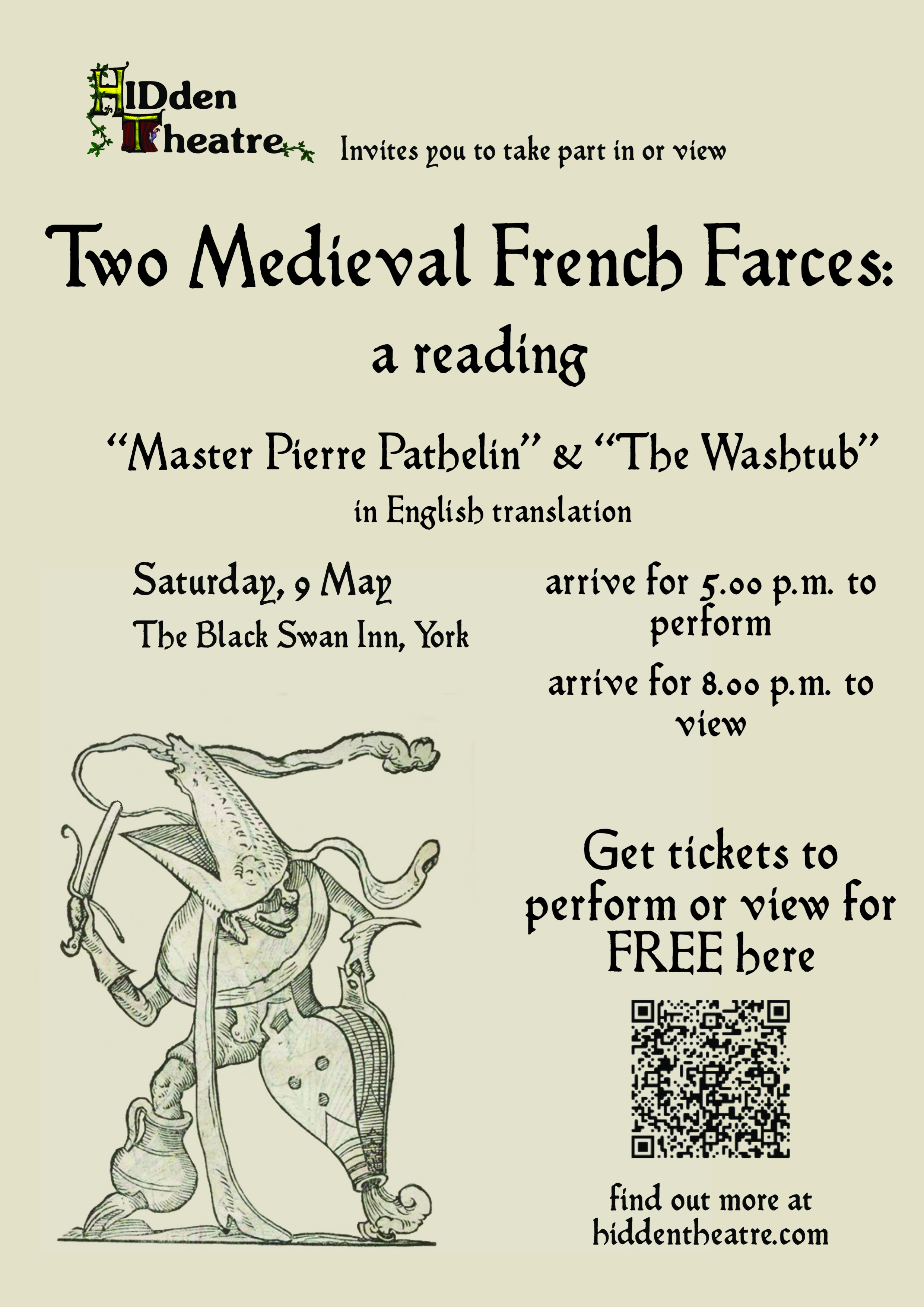
Two Medieval French Farces: A Reading

Click here for all the details.
(excerpts from both plays now included to give you a taste of what to expect)

A Taxonomy of Farces (Maybe)

Think you know what a farce is? Maybe nobody really knows! This week’s #FarcesFriday looks at scholarly debate about what medieval farces are, aren’t, and how to tell them from other styles- or not!

As humans, we like to label, define, and classify. It’s part of how we make sense of our world. This can be problematic, like when we assume people fall into stereotypes rather than seeing them as nuanced individuals, but it can also be extremely useful in making sure that, when we’re communicating, we have the same understanding of what we’re talking about. It’s all towards making sense and being understood.

For several weeks we’ve been talking about “medieval French farces”, and the fact that we didn’t lead with this particular essay tells you that we- like you, mostly likely!- didn’t feel like the word “farce” required a definition or explanation. After all, it’s not a rare word; in fact, when I was doing some initial reading with an eye towards proposing this project, I felt like I was seeing the word farce in the news almost daily. (Interestingly, when I checked Newspapers.com for use of the term “farce”, I expected the political section to be where it was found. But, while not infrequent there, it wasn’t where farce shows up most often. It’s most frequently used in the sports section!) If we can use it so readily, if the news can bandy that word about, then… surely we all know what a farce is, whether theatrical or otherwise. Right?

Well… not exactly. We’re probably okay on the “otherwise”, news-usage category, but scholarship debating the question “what is a farce”, particularly a medieval farce, has a lengthy history, and it does not seem to have ever become a settled answer. Moreover, there is not a linear direction of travel (“we used to think this but now we believe that”). You can’t pinpoint a specific understanding to a particular time; the ideas come and go and multiple arguments exist simultaneously to debate amongst one another. Any of these people can or could probably claim far more knowledge of this specific genre than I, so my goal here isn’t to take sides. Rather, it’s to illustrate for you just how messy this question is, so that when you next see a medieval farce (hopefully ours! this summer!) you can make up your own mind about how you’d define it.

On the surface it seems easy to posit that if drama is split between tragedy and comedy*, then farce is clearly a subgenre of the latter. However, some scholars have posited that farce is actually a third type that sits between them, particularly because so much of farce humour comes at the expense and discomfort of someone else. If one person’s laughter is directly at the result of another’s degradement, how can it be assigned either category? It’s tragedy for one character, comedy for another. At least one scholar suggests that comedy is probable while farce is so exaggerated as to be impossible in real life. This is just one example of how different opinions align farces within the dramatic tradition.

If we assume that farce is indeed a subfield of comedy, then defining farce often means separating it from other forms of comedy, particularly types unique to medieval France, such as the sottie and the morality. Some models suggest that they exist on a spectrum: farce is pure comedy, a sottie is meant to be funny but probably has a more moralistic subtext, and a morality uses humour solely to teach a moral lesson, often using what is funny to say “this is what you shouldn’tdo”. Other scholarship spins morality off completely, seeing it as something totally removed from farce and humour. As morality is the genre most distant to farce in any model (though still within sighting distance!), I won’t dwell on its definition overmuch; I just want to point out that if you’ve seen any of our Mankind iterations, or are otherwise familiar with the play, it will be readily apparent that much of what is often taken to define a farce is present in a play that, in the English classification, is usually called a morality play. (It’s worth noting that defining any medieval drama can be slippery- are they mystery plays? cycle drama? biblical drama?; you can find all of these terms used for the same plays!)

So, sotties and farces. They’re the two types most closely linked and fought over, in terms of taxonomy. It seems to be a minority position, and perhaps an earlier one rather than current, but some scholars have felt that the title determined this, since there are plays clearly titled with one term or the other. Particularly in early scholarship, it was posited that where a play sat on the afternoon’s playbill could be considered in trying to name the type. (“Farce” originally meant “stuffing”, as in “stuffed into a programme of other entertainment”.) More commonly, the argument is that some internal component is what separates them. Some believe it’s the characters: named characters are more indicative of farce, while allegorical or “type” names might suggest a sottie. One school of thinking is that the determining factor is who is performing them; a “company of sots (or fools)” would perform the eponymous sotties, while other similar fare performed by an acting troop out of fool costumes would perform farces. 

Content is one of the most complex aspects that many farce scholars believe make the difference. I won’t go as further in depth as this issue really deserves, but suffice to say that the contradictions in theory are plentiful! “Farce is more like a slice of real life, sotties are more stylised, exaggerated, or absurd” might be the summation of one argument, while another writer will tell you that what defines a farce is how “stylised, exaggerated, and absurd” it is. Indeed, the “ordinariness” of characters and story is frequently mentioned in defining farce, but the “clowning” and slapstick or improbability is mentioned equally often- can it encompass these together? Do sotties contain more or less slapstick than farces? If sotties are indeed played by “fool” characters, does that make a difference on the slapstick question? And does verbal humour versus visual humour place them in one category or the other? 

The intention of a play is no less debated, and may or may not factor into defining farce from sottie from morality. Is a farce’s sole purpose to invoke laughter? Some argue that the answer is yes, and that is one of the defining features of a farce. Others, however, that none of these forms- or perhaps any drama!- is intended solely for amusement, without any potential subtextual lessons or food for thought. Is a sottie inherently more satirical than a farce- or is satire something entirely different altogether? Where is the place of allegory, particularly between moralities and sotties? It is probably also fair to question whether intent can actually be divorced from content, or whether the two aspects are inherently in service to one another.

And there’s the vexing caveat inherent in all of this. Almost everyone agrees that, however one chooses to define farce, sottie, morality, or comedy, there are always going to be outliers, plays in the medieval French repertoire that just don’t fit any model particularly well, or fit very well… except that one little detail… That detail may be so unique that it doesn’t argue for throwing out one’s entire framework, but it will always be a weak point, a place for someone else to begin developing a different argument that will fit most plays very well… except that one little detail….

So much of the previous paragraphs have been laid out as questions rather than answers, because these are the heart of academic disagreement and complexity of thinking, which means they’re also some of the most interesting places to ponder if one is seeking to create a Taxonomy of Farce. I would love to tell you that I had the answers, but if scholars far more versed in this niche specialism haven’t managed it over the past four centuries, I cannot pretend to be their better. With regard to our own pair of plays, The Washtub seems to fit fairly neatly into various taxonomical models, maybe not always under the same headings, but it doesn’t itself seem to be a freak. Pathelin, on the other hand- and this may be why it’s held in such high esteem- almost never seems to fit easily into any model; it seems so much an outlier, though it’s historically been labelled as the pinnacle of medieval French farce, that I almost wonder if it isn’t the dramatic equivalent of a missing link, fitting neatly into no easy category because it represents the bridge between them.

In the end, I am left with the famous words of the late US Supreme Court Justice Potter Stewart, who, charged with coming up with a legal definition for smut, replied, “I can’t define it, but I know it when I see it.” I daresay most of us would feel exactly the same way about farce. Whether or not we’d be correct remains for debate in the halls of academia.

*In the modern usage, which I intend throughout this article, “comedy” and “tragedy” are usually understood to be defined by a generally happy or unhappy outcome at drama’s end. Ancient Greek drama used these terms to mean the characters were high status or low status; the emotional output didn’t matter.

Wondering where all this comes from? Closer to the performance we’ll be sharing the bibliography of the sources that inform our work on farces, so stay tuned!

Director’s Notes: Lost and Found in Translation

For this week’s #FarcesFriday, our director discusses the process she used to turn medieval French scripts into modern English, and how language takes a role in one of our plays.

            Let me begin with an admission: I don’t speak French. (At least, not yet!) My lack of multilingualism is one of the things in my life that I deeply regret, and I have Opinions about the lack of languages in early education in America that contributed to this. The reason I’m leading with this information is that tackling medieval French farces comes with some extra challenges, and that a knowledge of language- or lack thereof- actually plays an important part in Master Pierre Pathelin. 

            My first order of business was to round up as many iterations of Pathelin and The Washtub as I could- in modern English, in modern and medieval French, in clear cases where the words “inspired by” could be appended to what were very loose adaptations, even in one case a manuscript facsimile that I couldn’t possibly read. The point was to get a sense of what seemed essential to the text, and what approaches other people had taken (if, for example, it was clear just from comparing structures and lineation that entire chunks had been excised for a particular edition, that was information worth having, especially because, as you’ll see, I would also cut certain parts from the “original” for our script). It also gave a sense of the evolution of how the plays were received: the early twentieth century, for example, invariably “cleans up” anything deemed offensive, while more recent iterations take a more warts-and-all approach that prioritises the historicity of the piece.

            Then I fed every non-English version I could into a couple of language-translation websites. Yes, I know Google Translate isn’t always that fantastic! That’s why I used more than one, to check them across one another. And then I compared those results to all the modern English translations in books, to see if they were in the neighbourhood of translations created by actual humans who are competent in French. 

            And then, with more than a dozen versions laid out on a table in front of me, I wrestled out our script. What, of the options that made the most sense, sounded best? Were there parts that were just too idiomatic to translate at all? Were there lines that every single translation, book and online-translator, agreed upon? I won’t lie- this wasn’t fun. I’m genuinely terrified that I’ve got something important wrong. As a final fail-safe, before it goes out for reading and performance, it will be read and critiqued by someone who does read medieval French, and can tell me if I need to do some serious editing, or if it’s come out as a reasonable version of the plays. 

            As much as this process has been, let’s be honest, neither easy nor fun, I have no regrets about the time that’s been put into it. On a personal level, it’s inspired me to really attempt to learn French! (Just doing this much work on it, I can definitely read more of it than I could before this project came along.)

            But the major reason this work is pertinent applies to the Pathelin play in particular. (The Washtub doesn’t use language as a dramatic plot-point.) In one of the scenes, Pathelin tries to convince the clothseller that he, Pathelin, is sick to the point of being delusional. He does this by babbling random things in various languages and French dialects. He may be spouting imbecilities in terms of content… but he is actually speaking in those languages, or at least a reasonable enough degree that translation is possible. Yet it’s worth noting that, probably like my own efforts, there are those who have called into question just how much of those languages Pathelin had correct, and how much was true gibberish. If his skills are up to this feat, it’s an incredibly impressive one, given his background as a man who claims more education than he actually has. But to those who have said it would be impossible for the writer to create this scene with knowledge of such breadth… well, let’s just say that I have multiple friends who, though not professional linguists, can comfortably read and write in more than a half-dozen languages, so I am unconvinced by the impossibility of this! It’s worth remembering that, for the upper and professional classes of medieval France- the people who would have written these plays, and at least a reasonable portion of their audience- being at least moderately bilingual was not unusual, as they would have needed French and Latin to conduct legal business, and while education was a privilege, classical languages were seen as a normal part of education, not as luxurious extras.

            Having attempted to put together a plausible iteration of Pathelin, there remained the challenge of putting that scene back into some sort of language that wasn’t English, but would be at least potentially identifiable- knowing whathe’s speaking is part of the joke. I have seen several suggestions on how to achieve this: use the original language, use your own language’s dialects, or use whatever “nonsense” your language might offer up. I felt that using the original language was an enormous lift for actors, especially as this project is for a reading, where they won’t be spending months wrestling with how to pronounce and memorise lines of medieval Limousin or similar. Sadly, dialect in English is mostly moribund- though I hold very dear memories of trying to understand my late adopted grandfather’s delightful Yorkshireisms, neither his children nor theirs use those words and phrases. Instead I went with the third option: modern nonsense, in the form of Pig Latin (familiar enough to most children) and what the internet informs me may be a version of “bubble talk” or “ob”, but I grew up knowing as “Jabay Tabalk”, ‘Jay Talk’, named after the family friend who taught it to me. (I considered trying to use Cockney Rhyming Slang, the one seemingly-nonsense language I do encounter among adults occasionally, but I couldn’t make sense of how an entire paragraph would actually work, and I don’t want to mock a genuine cultural phenomenon.) Hopefully, these choices will result in something not necessarily automatically coherent, yet familiar enough to be recognised as ‘nonsense’! 

            This is also where I must confess to some excisions. The scene with different languages in Pathelin is quite extensive- extravagant, really, in its delight in his macaronic prowess! But it can grind the play to a juddering halt; the point is quickly made, and, dramatically, doesn’t require quite the belabouring it gets. I’ve cut it down to giving Pathelin just two “babbling languages”, just to keep things moving. It loses some of the delight of excess, but it’s dramatically more sound.

            I hope that the result of all this playing with words is a pair of plays that keeps the comic spirit of the original, even if the words aren’t quite the same, and that it even briefly allows the audience to consider just what can be done by playing with language, although I don’t recommend taking any lessons from Pierre Pathelin himself, however clever he is with speaking them.

Director’s Notes: Comedy Tonight!

It’s #FarcesFriday, and our director, Laura-Elizabeth Rice, is back with reflections on choosing to work with medieval French farces, and how we chose our plays.

Two memories:

I’m six years old, listening to a group of boys sitting around one’s school desk. One of them is using a hand under his armpit to make noises that mimic gas, and they’re laughing like it’s the funniest thing they’ve ever heard. And I find myself thinking, I can’t wait to be an adult, so people won’t find fart jokes funny anymore, because they aren’t! (Oh, the innocence of youth!)

I’m eighteen and in university, in a class that’s supposed to be on Chaucer’s Canterbury Tales, but our professor has decided that, instead, we’re going to be focusing on the question of “what is comedy?” He’s a young, early-career lecturer; it’s painfully obvious that he’s anxious to spit out the silver spoon he was born with, and his way of doing this is to argue strenuously that slapstick is the only valid form of comedy, because if you like anything else, you’re being a snob. I don’t think slapstick is funny at all. I’ll spend the semester arguing that watching someone be injured or made to feel embarrassed isn’t amusing, and that I don’t think that inherently makes me stuck-up.

I’m sharing these memories because it’s deeply ironic that I, of all people, should be spending time working on farces, a genre that relies heavily on physical and/or bodily humour… and irony is often a foundational part of comedy. Moreover, it’s worth knowing a little bit of that background, to help explain why, of all the farces in all the theatre in all the world (or at least, in France!), we should have settled on Master Pierre Pathelin and The Washtub for our upcoming reading.

Medieval comedy isn’t absent from the English canon of dramatic literature, but it’s quite limited, and exists entirely within wider dramatic genre that aren’t focused on laughs. Joseph’s Trouble About Mary is pretty funny, because it’s a pragmatic look at a Biblical moment that is usually held in pure reverence. The Second Shepherds’ Play is a strange combination of comedic folk play married to the more standard Christmas story. Our old friend, Mankind, has much bawdy humour, but its purpose is to be held up as an example of what not to be. There just isn’t a vast body of secular comedy from medieval England that exists solely because people wanted a laugh. 

It’s different in France. There are hundreds of farces from medieval France. Unfortunately, the majority aren’t available in translation; if you don’t read French- and medieval French at that!- these plays remain largely a literal and metaphorical closed book. This is changing (most notably, several collections translated and adapted by Jody Enders, which I highly recommend as entertaining reading even if you have zero interest in putting a farce onstage), but a lot– the majority- of the enormous body of farce remains just out of reach. So while I knew that, in deciding to present a comedy, we would be looking past English borders, the language question meant limitation among riches.

That said… once you start reading what is available in English, you confront the challenge of translation that isn’t about language or even France vs. England, but about cultures across time. My undergraduate lecturer was correct that slapstick has indeed stood the test of chronology- medieval people would have understood those six year old boys!- but the line of what is acceptable has definitely shifted. It’s quite shocking to realise that a significant percentage of medieval comedy is about violence, particularly domestic. Imagine watching a “Punch & Judy” show but with actors instead of puppets; men and women may give as good as they get, but the violence is unrelenting. There are those who argue that it is so exaggerated that it becomes comic, because it’s completely unrealistic, but we still felt it was over the line where we felt comfortable. 

The Washtub is marital comedy, but it still works as comedy if one ignores or excises stage directions that indicate the couple being violent towards one another- that is a disposable “extra” that isn’t necessary dramatically. Even without that, there is physical comedy, and it follows the slapstick trope of exaggeration of physical events: it’s unlikely that a grown, fully conscious woman would drown by falling into even a large medieval washtub in her own home; all she has to do is stand up! Thus much of the comedy centres around the absence of injury that the audience appreciates, but the character doesn’t; the rest is clever one-upmanship between spouses, of the sort that is still a staple of television sitcoms.

Pierre Pathelin is probably the best-known medieval French farce- possibly the best-known medieval French play, full stop, and I suspect that one of the reasons this is true is because it almost totally lacks violence-as-humour, so it hasn’t turned the corner into being more offensive than funny. It pokes fun at lawyers (another tradition that has carried on!), at unearned pomposity, and the idea of the clever scoundrel getting away with one-upping those considered his “betters” still resonates. It also includes a twist at the end that reminds me that my university lecturer did make some good points: reversal of expectation can be one of the criteria for defining comedy. In Pathelin, everybody is trying to cheat everyone else, and virtually everyone has some comeuppance along the way. 

I suspect that the same thing that made me read these plays and say, I want to do this!, is the same thing that has made them the best known among a fairly obscure genre: their surprisingly delicate balance between the hyperbolic actions of slapstick, and the jokes that ask the audience to contribute some thought or knowledge. You can appreciate them for exactly what they lay out in front of you- isn’t a man bleating “Baaa” in a courtroom ridiculous?- or you can be entertained because you know something about law and what Pathelin is faking. Or both. Meet them where you are. The medieval French writers gave us plays which understood what neither a younger version of me, nor my university teacher, did: that “funny” needn’t have a hierarchy; there are only different, and complimentary, ways of making an audience laugh.