Revisiting Mankind

Programming upcoming shows is often a challenge; there are a lot of factors that go into the decision of what we’ll be working on (and there are always a lot more ideas in the works than you see at any given moment). We want to find plays that will be interesting for our audience, and which give us new challenges. Particularly given this latter consideration, it may seem counterintuitive to revisit old ground, but on occasion it feels like the right decision.

Our autumn production in York, “Mankind”, is one we’ve played with before. Last February we staged a reading of it for an academic conference in Bristol. (You can read some of our thoughts on that in earlier entries on this page.) After completing that project, we agreed that it would be nice to stage it as a full production. We had a lot of fun with it last winter, and we had a terrific cast who really put a lot into it, but the same circumstances which made it a reading rather than a full performance meant that we felt there was a lot more to be got out of the play. “Mankind” is a pretty physical show- after all, the dichotomy between the desires of one’s earthly being and man’s higher ideals is what it’s about. The demons should really get a chance to interact with the audience, to put into physical being the sense of fun that is so seductive to Mankind.

The nice thing about re-exploring a familiar show is that you have the chance to look at different parts of it, to emphasize different things, and to use what you’ve learned previously. I remain convinced that a sympathetic, approachable, and above all human Mercy is really the linchpin of the play. Without that, Mankind’s despair has no remedy, but moreover, he has no concrete reason to return to Mercy’s precepts. A more restrained set of demons, however, allows for a quieter interpretation of Mercy; with the demons really let off the hook to play, Mercy will have to possess a greater strength, and on occasion anger, to balance them. This is not to suggest that any of the characters should tip over into becoming caricatures; on the contrary, their ability to remain real is maybe even more important, particularly if, good or evil, they are making an attempt on the souls of the audience as much as Mankind.

A second look at a show is another chance to tease out new things. After all, with historic drama, every time a show is revived, it’s getting a new life, a new look, and adding a new layer to its own history. And every show comes with a new cast, and each new group of people bring something different to the table. I’m looking forward to taking another look at “Mankind”, and see what turns up. Chances are, it’s something I haven’t even imagined yet.

IN CONVERSATION: WOMEN AND THE MUSIC HALL

I recently had a long chat with Lola Wingrove, our collaborator on ‘The Vital Spark’ and an expert on women in Victorian music-hall performance. Many interesting issues were raised in this conversation, which we hope will come through in the finished work. We’ll be posting some of this discussion here, to give you some background, and also as a window into some of the things we think about when putting together a play about the past.


Laura Rice: Are there a lot of women in music halls at this point? Obviously we’ve mostly talked about Jenny, but you’ve mentioned Vesta Tilley, Bessie Bellwood, Marie Lloyd… are there a fair number of women doing the same thing?

Lola Wingrove: When Jenny Hill started her career, it was still a little bit rarer and she was quite pioneering in her performance style of doing a lot of political performance, but it became a really big thing. In fact, in 1891, there was a report in the Theatre and Music Hall Journal that stated in the run-up week to Christmas, out of all the sketches that were on in London at the time, there were 76 female comics starring in them, and only 74 men. There were actually more women, although not by much, it was pretty much 50-50, but a little bit more women. And when you look through the newspapers (although at that time, the male and female adverts are separated) and you look through the lists of the female comics and serio-comics, it’s huge numbers, really massive numbers. People don’t think [of them], but there actually were an awful lot of women.

LR: We have such an image of Victorians being anti women in general, but on stage in particular. I know there’s a number of really famous “legitimate”, quote, actresses around from the same period, but you don’t think of them as being an equal number, in professional performance, at all.

LW: I think the thing is, there were a lot more legitimate actresses, but they were still always thought of as being a bit loose moralled. But I think the difference with the music hall performers is about class. There are quotes at the time about platform women and suffragettes, about how it was unwomanly to be seen to be speaking in public, and this sort of idea, but a lot of the music hall performers were working class and were very poor when they started off their careers, and so in a weird sort of way, I guess they probably didn’t mind losing their reputations, they made up for it with the ammount of travel, money, and independence they could get from the music hall stage. A report from 1981 says that on average an actress in the legitimate theatre would get about two or three pounds a week, to live off, to buy costumes for the shows they were in, all that sort of thing, whereas around the same time, Jenny Hill would get about 80 pounds for twelve nights’ work, and would get lots of benefits thrown for her. She’d be given diamond jewellery, and be given all sorts of presents and things. I think women started to see that if they went on the hall stage, they could earn a ridiculous amount of money, and they had a really good say in what material they did, so although they were still looked on as being loose moralled, and having that sort of reputation, they were earning so much money and getting to travel around so much, I think they said, ‘well,  screw it.’

Again, we don’t tend to think of [women onstage], I think partially because of the fact that these women were belittled quite a bit by the press or weren’t  reported on as much by the press, and theatre historians since then haven’t really looked at them too much. But actually there were huge numbers of them doing really interesting work.

LR: And a woman was actually better off, financially at least, making a career in music hall than as a ‘legitimate’ actress?

LW: If you were good enough- Jenny Hill  got asked to perform as a ‘legitimate’ actress but she always turned those offers down, because the pay wasn’t good enough. That was the main reason she wouldn’t perform in “proper” theatre, it just didn’t meet her pay criteria.

LR: That’s fascinating, because you’d really expect that the kind of theatre higher up the social ladder would come with a better paycheque.

LW: In legitimate theatre, the women were normally just a supporting cast, there weren’t a huge amount of fantastic roles for women at that time, they were normally weak or portrayed as being hysterical. In terms of casting, [music hall] was much better- you could show off your talents. It’s Fanny Lesley, I think, who was talked about how, in the music halls, she actually got to dictate exactly what material she sang, what she did, so if she made any failures she only had herself to blame. But it’s that kind of idea, that the music hall stars didn’t want to go into the legitimate theatre, because they’d just be cast in these plays which didn’t really have any good roles for women in particular. You didn’t have that many options in legitimate theatre, while in music halls they could dictate their own material, get lots of money, and do whatever they wanted.

LR: It’s interesting, given how narrow our usual view of Victorian women and their world is, to realise that it’s both a financial decision and an artistic one, where playing music halls gives women more artistic flexibility and autonomy, and that was definitely something they wanted.

LW: That’s one of the things about Jenny Hill. It’s always made out [in the newspapers] like she had to perform because there was nothing else she could do, and it’s overlooked a lot that, actually, she always wanted to perform and it was her sort of obsession, and it was definitely her talent. She did actively look to do it. And the press tried to undermine her in lots of ways; they kept trying to pretend it was really bad for her health, and they would always call her a ‘clever little thing’, and they tried to imply that her farm in Stretham was bought for her by someone else, a secret male lover, or something like that. And therefore she would counteract it with all these adverts where she would put in exactly how much she was earning, to show people that although she was being framed in this sort of way, she wasn’t really like that, she was earning this money.

LR: So she’s really savvy about PR, and about making this a financially very rewarding career, and she’s also stubborn about having her autonomy and making sure people know about it. Such an interesting person, and she seems to go against so much of what we think is true about Victorian women. I can’t wait to get Jenny ‘back’ on the stage again!


In Conversation: Finding Performance on History’s Pages

I recently had a long chat with Lola Wingrove, our collaborator on ‘The Vital Spark’ and an expert on women in Victorian music-hall performance. Many interesting issues were raised in this conversation, which we hope will come through in the finished work. We’ll be posting some of this discussion here, to give you some background, and also as a window into some of the things we think about when putting together a play about the past.

Laura Rice: What kind of documents do you get to work with and what is your process like in trying to figure out what she did, how do you go about that, what are you working with and how do you get there?

Lola Wingrove: At the moment I have quite a widespread methodology, and my sources, they’re all really intrinsically linked. I rely an awful lot on newspapers, because by looking at how Jenny Hill advertised in newspapers and reviews, I’ve been able to plot over her whole career, where in the country she was at what time, what kind of performances she was giving, what songs she was performing in what halls at what time, a little bit [about] how successfully it went down. Reviews and adverts are really integral to at least knowing what she was and what she was doing in what year. Most of that is accessed through the British Library Newspaper Archive collection. I use them a lot.

In addition I use the newspapers for gossip columns, to find out what’s going on, and also for interviews with her, because how Jenny [told] her stories is particularly important, seeing how she showed herself in that way. But there’s obviously a huge amount of bias taken up with that, because reviewers and interviewers could change it to be what they wanted. I mean, we don’t have that scrict a demand for truth in press nowadays, but definitely at that time anything went.

Hill was also an obsessive letter writer to newspapers, so if ever they got anything wrong, she would write a letter saying, “You got this wrong, change it,” and that’s so useful. There are so many letters from her. When she became ill and couldn’t perform anymore, she just kept writing letters to them. “So, my garden’s really nice…” She was determined that no one would forget her. She seems to have said, “I will write letters and I will remind you all that I’m still here, even if I’m not performing!” So I use all the newspapers,

LR: Are there other sources of information that have been especially useful?

LW: I’ve looked a lot at the sheet music that is available [from Jenny’s repertoire], which is mainly held at the Bodelian Library, in Oxford, and with that I’m trying to analyse the sheet music cover, the illustrations, how much it cost, etc.,  in order to get an idea of what sort of audiences were hearing it and buying it. And I’m also analyzing the lyrics to find out socially what was happening, why these lyrics were particularly piognant to them at the time, and I’m actually doing some recording. I’m doing case studies of six of the songs, three for Jenny Hill and three for Bessie Bellwood, where I’m recording myself singing and performing the songs in order to get an idea of range, and how difficult some of the words would be to sing. By trying to perform it in a funny way, you kind of get ideas of how it could have worked- say, probably they put a lot of emphasis on that word, actually, because if you put emphasis on that, it means something else. So I’m using performance of sheet music in order to get a good idea of  that, and I’m actually analyzing the music itself for things like dynamics. But again, that’s kind of biased in some ways because it was for a very specific audience and could be edited, and I’ve got to acknowledge that. But when you mix the music in with the newspapers it creates something quite interesting.

I’m also doing case studies of the music halls themselves. I’ve been looking at five or six music halls that I know the case study songs were performed at. I’m finding their programmes and posters and bills and things, in order to see what kind of performers they had at the same time as Hill or Bellwood, how much their programmes costs, how much their drinks were…. The programmes also have public transport links, and how much it would cost to get from different areas, so you can get an idea of what kind of audience would have been at those halls, in order to enjoy the material that was on offer there.

And I’m also accessing the LCC, the London County Council records for- it sounds weird, but- health and safety issues. The halls all had to fulfill quite strict sort of moral and health and safety codes, and so I’m looking that up to understand where certain members of the audience were sitting, how many exits they had, how safe it was, what kind of gas lighting they’d got, or electric eventually. And so I’m using case studies of the halls to understand what songs were being performed there, what the halls were liked, what reviewers were saying about those halls, to get an idea of the space in which Hill was performing, because then as soon as you know what kind of performance space she was in then you can imagine the song being performed in that particular setup. Who was close to her, were the galleries where most of the working class people were sitting far away or close to her?

LR: I would never have thought of using those records like that! It really shows how wide a net you have to cast to really get a full picture of performances from the past.

LW: And of course there’s general social history, really, looking at how the suffrage movement was going at the time, with the suffragists- not the suffragettes at that time- and looking at how common women being able to speak their mind was at that time, things like that. By using a mixture of social history and these other documentations, it’s about getting a fully rounded idea of who Jenny Hill was. It’s all about pieceing together these otherwise very biased sort of things, but then you put them next to eachother and and compare them all, you kind of lower the bias a little bit, because one checks the other one out, so you see, well, the reviewer might have said that about this song, but clearly from the sheet music it wouldn’t have been like that at all, you can kind of move them in that way. So it’s quite a wide methodology, but that’s how it’s working at the moment.

ESSAY: The York Mystery Plays Conference 2015

This past weekend, the entire HIDden team attended the York Mystery Plays conference at the National Centre for Early Music, in part because we were also reviving our production of “The Baptism” for it, but also because we like to stay abreast of what is going on with the continuing life of the cycle.

The focus of the conference was on the future of the mystery plays. The waggons have been rolling through the streets on a quadrennial basis for 21 years; as more of the people who have made them possible are retiring from their longstanding roles and as York itself continues to evolve, there is definitely an awareness that the years ahead must be approached very consciously and deliberately.

One of the prevailing strands of discussion was that of tradition versus innovation. This is not a particularly new debate, but it’s one that inevitably renews when contemplating how the plays will be staged in the future. The simple act of defining what their “traditions” are is challenging: for example, the longer “tradition” in living memory is that of static, large-scale productions, like the 2012 version in St Mary’s Abbey ruins; the medieval and more recent “tradition” is that of waggons throughout the city streets. Both have an equally valid claim to a role in the heritage of historic drama in York (and now that both are happening in offset four-year cycles, hopefully they will complement one another, rather than be seen as competing for the title of ‘real’ mystery plays).

Likewise, within the waggon-production community, there is often discussion and debate about how “historical” the plays should look and feel, or how much performances should change from year to year. Some groups are relatively locked in to a particular staging, due to large investment in purpose-built waggons. Some start from scratch every four years and reinvent their play, or perform different plays from the York Cycle altogether. Others tend to find a way in between. Among these variations, there has generally been a balance of plays which owe much of their character to the Middle Ages, plays which are experiments with techniques of modern drama, and pays which are designed to add colour and spectacle without being tied down to any greater theory or concept. This variety makes for a vibrant cavalcade of theatre throughout the streets of York, but there is also an argument that, for audiences who are as mobile as the waggons, this variegation may make it difficult to follow the (already episodically disjointed) story, particularly as younger audiences are less grounded in biblical lore. The follow-up discussion arising from the debate about tradition goes to the role of the overall artistic director: should he or she impose a style or theme upon all of the plays in the interest of cohesiveness? Or should groups function autonomously? Is there even the need for an overseeing artistic director?

Another controversial change from 2014 was the addition of a chorus- newly written to frame the plays in a greater context, it was intended to act as a bridge in places where there was either a large time gap in the narrative story, or where some further elucidation was helpful. The addition of the chorus (which did not exist in the medieval cycle of York, although other cities set the precedent) was one of the most debated subjects last year, and was of course much discussed at the conference as well. The fact that it is new and not traditional makes in a focal point for the greater debate about the role of addition and adaptation in historic drama.

Jane Oakshott’s keynote speech was therefore quite heartening. As the person who brought the plays back to the waggons and the streets in 1994, she is a strong advocate for historically informed drama. She points out that this is not synonymous with attempting to recreate the past, but that any historic play will be most successful if the people staging and acting in it have a solid grounding in its greater historical context. We at HIDden heartily concur. The tension between the past and the present is what makes our work so interesting. While we would not want our own productions to turn into a reenactment exercise, we would argue that changes and adaptations should always be thoughtful and deliberate, in aid of the play itself, and not simply for their own sake.

Many of these conversations are familiar. They are issues that have been discussed within the mystery plays community in the past, but there seems to be more urgency in the question of how their torch will be carried forward to future generations. Coming up with answers, however, remains challenging, so it’s worth keeping an eye out for their future development. Whichever way the York Mystery Plays go, we here at HIDden hope to stay involved in some capacity. We will always be among their greatest cheerleaders for having given us our start and bringing us this far, and for all the wonderful memories and experiences the plays have imparted. We’re sure we’re not alone in this, so if you happen to be in York in a mystery plays year, keep an eye out for how you can be part of an amazing historical event. No matter what changes with them, we know from experience that being involved can indeed change you.


Memories From The Baptism


We’re very sentimental about York’s Mystery Plays- after all, it’s where HIDden began. The quadrennial event remains close to our collective heart, not just because of our history with it, or even because YMP really stands for a lot of the same things we do, but because we just had such a wonderful time working on that production.

Among the reasons we’re so excited to be revisiting the production for the upcoming YMP conference is that it gives us a chance to get our cast back together. We were extremely fortunate to have such a talented, dedicated, and personally lovely group of actors for The Baptism, and we’re equally lucky to welcome them back. We expect that our rehearsals will be full of fond memories from last year, and we asked the cast and crew to share some of their favourites before the event.

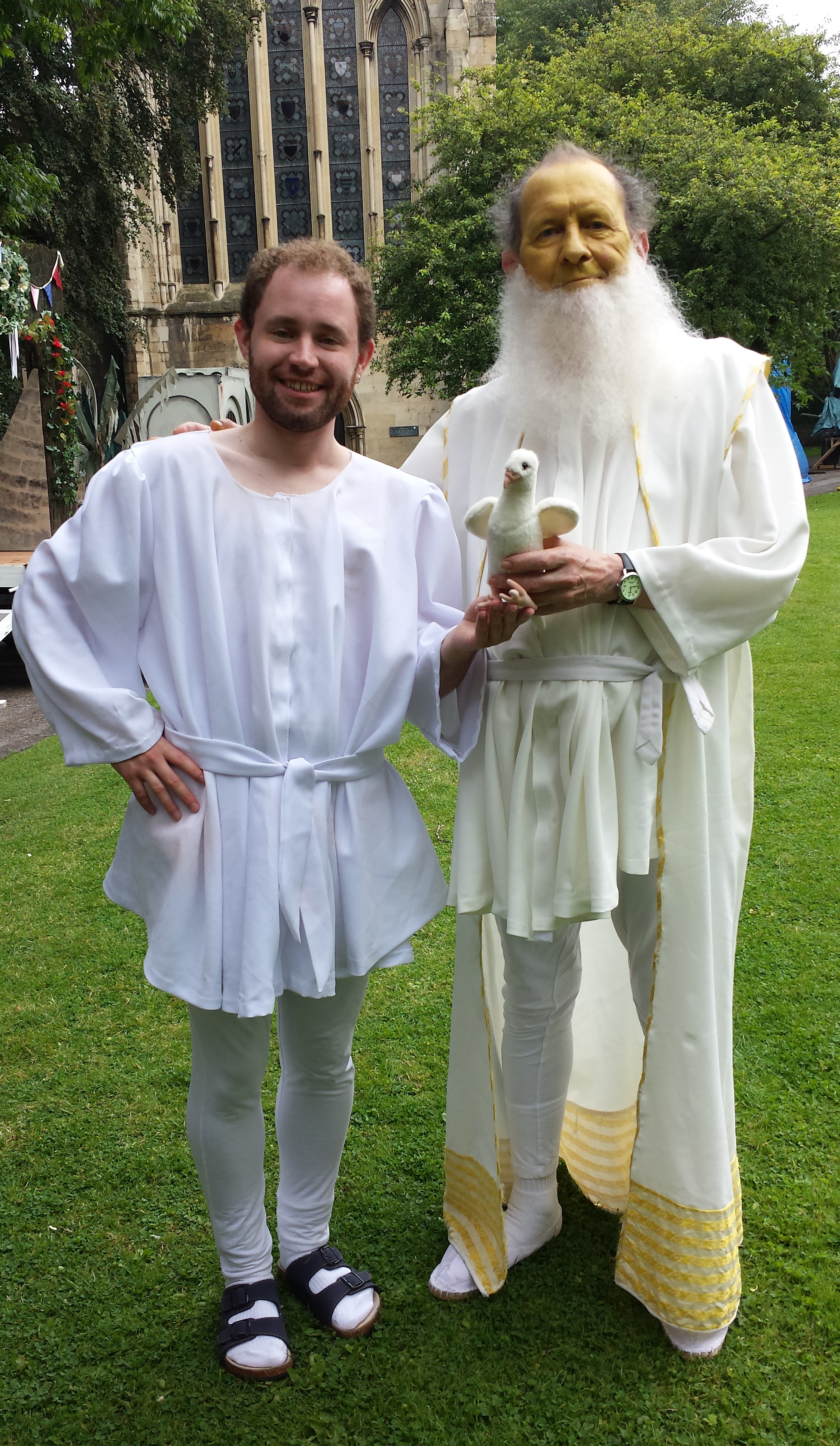
Charles Hunt (God) sent this photo. Taken in the Minster Gardens before our first performance, the joke was that it was a “family portait” of God (Charles), his son Jesus (Ehren Mierau), and the Holy Ghost as embodied by a dove.

Trinity

Kate Thomas (Angel) remembers the downpour that had us all trapped in the waggon works when the area around it flooded. We’d just finished a rehearsal and put the waggon away for the night when it started to rain heavily, and the puddle that formed at the gate to the waggon works rose quickly to take over the entire driveway. A couple people from another group were stuck in a corner on a high bit of ground, also surrounded by water. Eventually someone opened up a blocked drain, and the water went down right away. We reflected later, though, that perhaps we should have taken advantage of the situation and put our waggon in the enormous puddle: wooden waggon wheels are challenging to keep damp, but it’s the best way to keep their metal rims from falling off.

Rain was also a problem the first day of performance. After the waggons had come into town, while we were waiting to film for the BBC’s broadcast, the skies opened up and poured down on us. We weren’t sure if it would pass in time for the filming, and had quite a waffling around with whether or not the angels should wear their easily damaged feathered wings if it didn’t. We spent the time waiting in the seating, one of the only dry places available. At one point someone pulled out a pin, a nod to the old question of how many angels could dance on its head- all three actors managed to get a finger on it, but it wasn’t quite a dance!

Ian Murphy (producer) and Nathan Bargate (production manager) both recalled with a laugh an incident from the building of the set. There was a question of whether the throne seat was safely secured and Nathan tested it by jumping on it rather enthusiastically. It wasn’t, and he fell into the throne. While he was stuck there, a crew member asked if he could offer an idea. “May I suggest… a cushion?” was his idea- not exactly useful at that moment, but amusing to all present.

Laura Elizabeth Rice (artistic director) recalls the performance in St Sampson’s Square as a favourite moment, because it was such a challenging location, with lots of noise, footfall and traffic. The cast handled it brilliantly, adjusting to these circumstances without missing a beat. At the end, one audience member who had been passing through was heard to remark, “If I’d known the plays were all like that, I’d’ve come out to see more!”- one of the nicer compliments for being unintentional, and especially in a space generally considered to be difficult.

We could probably go on at some length- there are an awful lot of “favourite moments” from last summer- but of course right now we’re looking forward to creating new memories among the company and for the audience. If you haven’t registered for the conference, do consider it. The mystery plays, in any form, usually find a way to be memorable.

DIRECTOR’S NOTES: REVIVING “THE BAPTISM”

In most cases, a revival production doesn’t mean putting on an identical performance to an earlier one. It’s a chance to reconsider things, to make changes and what those producting it would probably consider “improvements”. After all, almost every show is a series of adjustments and compromises, many for very practical reasons, which hopefully do end up strengthening the finished product… but sometimes you do wonder what else a production could have been.

The Baptism is a rare exception. As we’ve been gearing up to put it on again, looking over old notes, photographs, and film, I’ve been reminded of how unusual that show was. No matter how I look at it, I keep coming back to the same thought: I would not change a thing. Of course there are infinite other ways you could stage it, some of which would work equally well. What made it ‘perfect’ in my eyes was the fact that it came out exactly the way it was intended. There were no compromises. It all just fell into place exactly as hoped, and those intentions were ones which worked.

The most important thing which went right in that production was, of course, our cast. While one tries very hard not to mentally pre-cast a show, I think every director has some idea of what their ideal would be, or at least what qualities they most want their cast to emobdy. Most importantly for The Baptism, I wanted actors who could make Jesus and John real. Medieval dramas are written to be extremely human, not at all the superhuman “plaster saints” that often characterize modern perception of Biblical characters. Moreover, only by making these characters emotionally real can the stories be compelling to audiences who aren’t present for spiritual reasons.

Jesus can be tricky to portray, since we tend to equate ‘holiness’ with ‘stillness’, and static acting makes for dull theatre. John the Baptist vacillates between anger, humility, and sanctity, all of which has to be played without going too far in any direction. Having worked with both Mark and Ehren before, I was thrilled when they were both available for the production, as I knew they would be completely capable of capturing these two characters as real people. Additionally, they have a great dynamic on stage together, which works so nicely for cousins Jesus and John.

The angels get to be a bit more formal and otherworldly, but they also need to be musical. It was so exciting to hear James, Kate, and Stephanie sing together- we realised right away that they would make a beautiful trio, and I don’t think, even after all the rehearsals and performances, I ever got tired of hearing them together. Stephanie, unfortunately, can’t be with us for the revival due to other commitments; she will be very missed! In what is probably the biggest change for this performance, we’re reworking the trio into a duet.

God doesn’t actually appear in the original version of The Baptism– it was the biggest liberty we took with the production. I’ve always liked the idea of using God as a constant character in the plays, even if he doesn’t speak or interact with the rest of the action, as a way of connecting the separate plays. His presence also has the ability to illustrate theological concepts that don’t really translate their meaning easily, which is why we decided to include him in our production. Charles might not have had lots to do during the play, but he was able to create a lovely paternal connection between God and Jesus as his son.

I thought from the beginning that the play didn’t want a lot of ‘showiness’ larded on to it- it should be simple, elegant, and dignified. The set and costumes had a medieval basis but I didn’t want it to be aggressive in its periodisation, and I think it managed to avoid that. Even the River Jordan, which was by far the most time-consuming piece to make, came out with the crazy-quilt effect intended.

If you had the chance to see us perform last year, the performance in August won’t be a big surprise. This is one occasion where it’s not about “how could we do it better”, but about revisiting something well-loved exactly the way it is. It’s nice to create a show with not regrets, and I hope that that affection we have for it is something, beyond the proverbial footlights, that we can share with the audience.

Our Next Production: Revisiting The Baptism

 We have exciting news! To our great delight, we’ve been asked to revive last summer’s production of The Baptism for the York Mystery Plays Conference on 1 August.

HIDden has always had a special connection with the Mystery Plays- it gave us our start. York’s plays are a unique event with a very long history, and it’s always an honour to be part of the community that continues to create new chapters of that story.

We’re also looking forward to reassembling the majority of our very talented cast! Mark Burghagen and Ehren Mierau will be reprising their roles as John the Baptist and Jesus, respectively. Our angels, James Wright and Kate Thomas, are returning. And our God, Charles Hunt, will be back in his heaven- all should be right with our world!

We can’t wait to get back on the waggon!

For more information on the conference, or to register, please visit: http://www.yorkmysteryplays.co.uk/2015-conference-1st-august-book/

In Conversation: The Late Victorian World of the Music Hall

I recently had a long chat with Lola Wingrove, our collaborator on ‘The Vital Spark’ and an expert on women in Victorian music-hall performance. Many interesting issues were raised in this conversation, which we hope will come through in the finished work. We’ll be posting some of this discussion here, to give you some background, and also as a window into some of the things we think about when putting together a play about the past.


Laura Rice: I think it’s kind of hard to get one’s head around music halls today, we just don’t have anything like it. We don’t have different theatres for different socio-economic classes. Theatre is generally thought of as a middle and upper class thing now, because of prices, and the theatre of the common, for everybody, is television and film, so we don’t have relationship with the idea that there could actually be separate theatres based on who you are.


Lola Wingrove: It’s quite interesting because things like film was basically what killed music halls, film and then television, and television is blamed a lot for the downfall of film nowadays, because if you’ve got it in your front room why would you bother going out. Most people seem to be staying in their houses and aren’t really interacting in the same kind of way. One of the biggest draws in music halls was their sense of community spirit and bringing everyone together and making everyone feel like they’re sort of mucking in together, so to speak. Yes, I think it’s something that’s quite foreign to us now, when we think about it, it doesn’t quite work out. It’s a really interesting theatre format, but people can’t quite understand it so much now.


LR: Do we have anything analogous? I feel like there are different programmes that are aimed at different groups, but it’s not quite the same in live performance.


LW: No. I know people [have compared] the TV show “Britain’s Got Talent” to the variety performance, because it’s the same sort of set-up of having people doing different kinds of performance, and you’ve still got that interactive quality, with people ringing in and voting and people talking about it in the street, and they’ll chat to eachother about it and read about it in the paper, so you’ve got that kind of weird community, in that it draws everybody in to talk about something in common. But one of the really great things that music halls did was actually reflect everyday life, a bit like soap operas do today, only the live format made it all even more immediate. They would have performers on stage that were performing for the people as the people you’d see selling stuff on the markets, or in the coffee shops. So although the kind of classed analogy is sort of there, it doesn’t totally work in that same sort of way. That’s why I think people have a difficulty understanding music hall.


LR: And the idea of variety, in a performance, because you don’t go to something where you’re going to see seven or eight different things, on potentially completely different themes in one night, we just don’t really have that anymore.


LW: That’s the thing, [there were] professionals going around and doing these different acts, and they would perform all across the country, so you’ve got professionals- animal trainers, acrobats, dancers, singers, comedians. And on the bills, quite often, especially towards the late Victorian period, the music halls would normally include a section from a ballet or an opera or something, so we tend to think of music halls as being these sort of rowdy, working-class kind of thing, and [we often think they were] a suppression, a way of keeping the working class away from the fine arts, but it wasn’t that at all. I mean, they were much better versed in ballet and opera and things like that than a lot of us probably are today, because of the fact that they would see it on a regular basis and get all these different acts. And we tend to think of the halls as being quite xenophobic because of the amount of patriotism and stuff like that, but for a lot of the halls, they actually employed lots of different acts from all over Europe, and there was a cultural exchange happening through the halls, which is quite often neglected and ignored as well, so it was quite a sort of novel and interesting experience. There are some acts that are just a little bit weird. Like, there was one guy and his whole act was just jumping up and down on the spot. No one has quite worked out why that was so popular, but he apparently just jumped up and down and everyone thought it was wonderful. But that’s the problem with performance history and archives, you can’t quite see how he did it in a way that was so hilarious.


LR: Where do their performers fit into the bigger arts picture of the times, and into society on the whole? I assume Jenny Hill wasn’t someone Queen Victoria was going to invite over for coffee, but maybe she would, I don’t know!


LW: Well, not Hill, but [her contemporary] Bessie Bellwood, she was invited by Princess Louise, by royal appointment, to sing one of her songs, because she’d heard the servants singing it and enjoyed it, so she invited Bessie Bellwood to go and sing to her. That’s how far it could go, if you had a really good, catchy song! Even royalty could invite you to perform.

I think at that particular time, because this is long before the royal command performance occurred, a lot of the middle and upper classes just tended to think of the performers as low and just weren’t particularly interested in them. They’d almost be sort of our idea of the reality show stars today, where if you were middle or upper class you’d probably have heard of Jenny Hill, and there are certain songs that you might even buy to play on your piano by her, but you wouldn’t exactly think of her in particularly high esteem. However, amongst the working classes… That is arguably a much wider base, because most of the classes would go to the halls, that was their main source of entertainment. Especially in the winter time when at home it would be very dark or you wouldn’t have enough money to get a fire going, you could go to these halls which were all beautiful and glittery and well-heated, so people would often go to the halls several times a week.

[With] that kind of audience base, performers like Jenny Hill were exceptionally well known, I mean they were really, really hugely famous, to the extent that when they died, in the funeral procession, they would have ten thousand people lining the street for them, these sorts of amounts. Definitely for Hill. Marie Lloyd was a very famous, she had twenty or thirty thousand lined up, lining the streets for her. So they were hugely popular and influential, with women in particularly. [Women would be] waiting for them backstage to give them presents. They had a lot of groupies, a lot of people were really sort of obsessed with them, and they were the stars who were used the most for advertising. They were the ones who were put onto cigarette cards or used to advertise [other things], in Vesta Tilley’s case it was clothes. And advertising gives you some power as well, so they were enormously famous, probably just because of that wide base, probably even better known that some of the legitimate performers, who arguably had the smaller audience base really.


LR: Is there any permeability between those two worlds theatrically?


LW: There was. Each year for pantomime the legitimate theatres stole a lot of the music hall and variety performers for their pantomimes, in order to get quite a lot more people in, and so even the middle and upper classes would have seen Jenny Hill in her numerous amounts of pantomime, so they did cross over to the mainstream theatres there, and there’s a lot of evidence of music hall performers being asked to perform, because even the legitimate theatres, they’d have a main play, but they’d quite often have a little bit of variety warm-up stuff before the main event happened, so they’d get performers like Jenny Hill to perform there. So there were definitely cases of that. And also, both amongst opera and ballet stars, there’s a lot of them finishing performing, and then going around to a hall around the corner and deciding to have a sort of knees-up but still perform again, and so there was quite a lot of moving across in that way. I don’t think there were so many legitimate actress who’d want to be seen on the music hall stage, so there’s a bit less in terms of cases of it going that way, but definitely in the other way it did work, and in fact I know they often said with Jenny Hill, that she was good enough and had been invited to perform in legitimate theatres as an actress.


The Vital Spark: A New Project

We’ve hinted at new things on the HIDden horizon. One of them is, on the surface, a big departure for us- but it’s very exciting. This is a new piece of drama, tentatively titled The Vital Spark. It’s the story of the life of Jenny Hill, the first woman to be recognised as a “comedienne”. Hill was a star of the late-Victorian music hall, who, like many performers since, combined humour, interesting characters, and a certain degree of social commentary.

Hill is the thesis subject of Lola Wingrove, a PhD candidate at the University of Bristol. I first heard Lola speak about women’s performance in music halls last year, and right away I knew there was a play in there waiting to happen. We chatted after her lecture about the idea of using her work on reviving Hill’s repertoire to create the basis for a play about the life of this remarkable Victorian performer. And now, in collaboration, we’re doing just that.

A new play… Victorians… on the surface, it’s quite different from what HIDden has done thus far. This project goes to the heart of our interests: a fascinating personality, and interesting story, and one that speaks to a specific aspect of the past, one that you might not know very well. Certainly it’s quite new to us! Moreover, it’s taking us all right back to the archives; there are no scripts left of Jenny Hill’s performances, and of course there is no film, so the challenge, to Lola as the writer and to the HIDden team in putting the production together, is to use original material to try to imagine what happened. As with our medieval productions, we know we’re not going to “authentically” “recreate” anything. What we’re hoping to do is to use the evidence that history has left us to create something new, something that will show you a bit of theatre history that you haven’t had the chance to see before.

Although we’re still in the early stages of this project, we’ve already learned quite a lot. In the weeks ahead we’ll have more interesting things to share with you: a bit about Jenny Hill and her life and times; the Victorian theatre; and just how we’re approaching the challenges of creating a new piece from historic documents. I can’t wait to see how it all comes together- it’s going to be an exciting journey!

Director’s Notes: The Missing Hell-mouth

There’s something about medieval hell-mouths. I think it may be the fact that, in so many manuscript illustrations, they look a little like confused puppies. Evil puppies, eating the souls of the damned, but you still want to scratch their ears and say, “Good hell-mouth. Who wants a soul-cookie?”

When initially planning for this production of Mankind, we imagined some form of a medieval hell-mouth, from which Titivillus and his minions could appear. Although we don’t know that there would have been one during any fifteenth-century productions fo the play, there are certainly modern-day precedents for such staging. This is not without logic: Mercy has his church; to give the demons something equal and opposite would seem to create a balance, and a spatial vocabulary for the forces of good and its antithesis. A hell-mouth evokes the medieval iconography, giving a sense of the era, and there is something charming and comical about the sort of demonic creature that is often pictured in manuscripts. It seems to fit well with the amusing evil of the Vice characters.

Choosing to stage the play in a modern idiom, however, a medieval hell-mouth felt out of place. Moreover, the more we thought about the play, the less sense it made. The Vices who dominate the play- Nowadays, New-guise, and Nought- may be demons, but they are, importantly, worldly demons. They aren’t lurking about in a nether world with pitchforks at the ready, they are the temptations of man’s everyday life. Though they speak of mayhem and murder, what we see of the Vices is their enjoyment of a kind of childish annoyance, at worse a distinct penchant for blasphemy. Most importantly, they are easy for Mankind to fall into because they are all around, constantly: daily irritations, pleasures out of reach. They can’t seem too overtly evil, or Mankind would, we presume, see through their games. (This is why the Vices only stay masked amongst those who are ‘in the know’- their own kind and Mercy. Mankind only sees them as people.) They need to be a bit sneaky, not announce their arrival from the fiery depths.

Additionally, Mercy is well outnumbered. The fact that Mankind includes one holy person and five evil ones has often been discussed, and is one of the reasons that early scholarship considered it a ‘corrupt’ play- surely something was missing, for the virtue to stand solitary against such overwhelming odds. There isn’t much need to balance the demons against Mercy with a hell-mouth when they are already, numerically, in the majority. Giving Mercy a specific location- a church, a lectern- lets him argue from a position of strength, while the Vices come and go, unmoored. There may be more of them, but Mercy is the stonger character. The Vices, without a ‘home’ of their own, may try to usurp Mercy’s position, in Mankind’s life and physically, but they do not succeed. Even Titivillus, the strongest of the demonic characters, must go invisible, be everywhere and nowhere- and Mankind still returns to faith, to Mercy and his church. Mankind, too, needs a place to return; we trust that the demons will go off and find others to torment.

So- no hell-mouth. I still want to build one someday, but I’ll have to listen to Mercy’s advise, exercise patience, and wait for the day when we get to do a Last Judgement from one of the medieval mystery cycles.